
From Material Selection to Prototyping: Reducing Late-Stage Direction Changes
In cleaning and disinfection environments, the quality of material selection decisions has a major impact on the efficiency of prototyping and production validation. Including cleaning conditions in material discussions early in development helps direct sample testing toward the right path from the beginning - instead of discovering after prototyping that the material needs to be changed.
1. Cleaning Conditions Should Be Defined During Material Selection Discussions
The type of cleaning fluid or disinfectant, concentration, temperature, exposure time, and cleaning method all directly affect how a material performs in practice. When we discuss component development with customers, the earlier this information is confirmed, the more precise the material comparison direction becomes - and the lower the chance that the material direction will need to be revised during prototyping. When submitting a component development request, we recommend providing the following information at the same time:
- Product name or chemical composition of the cleaning / disinfection agent, such as "X% NaOCl solution" or "IPA 70%"
- Cleaning temperature, such as room-temperature cleaning vs. 60-80°C hot water cleaning vs. steam sterilization
- Exposure time per cycle and cleaning frequency, such as once per day vs. after every operation
- Whether the component is soaked, sprayed, wiped, or exposed to flow-through conditions
The earlier this information is confirmed, the more precise the material comparison direction becomes, and the lower the chance that material direction will need to be modified during prototyping.
2. Prototype Testing: Exposing Samples to Real Use Conditions
Material property tables are a screening starting point, but component reliability ultimately needs to be confirmed under conditions close to actual use. The following are sample validation directions we often discuss with customers when prototyping components for cleaning / disinfection environments. Applicable items can be selected according to the device development stage and available resources:
| Test Item | Suggested Procedure | Observation Focus |
|---|---|---|
| Chemical soaking + visual inspection | Soak samples in the expected cleaning fluid at actual concentration and temperature, simulating equivalent use time (recommended to estimate by cleaning cycles) | Whether the surface shows crazing, discoloration, embrittlement, fine cracks, or swelling |
| Stressed soaking (ESC-targeted test) | Soak samples in the target cleaning fluid after fastening torque or press-fit pre-stress has been applied | Observe whether thread roots, thin-wall areas, or snap-fit areas show cracking; compare stressed vs. unstressed samples |
| Dimensional stability check | Measure critical dimensions before and after soaking, such as threaded-hole diameter, mating-surface spacing, and wall thickness | Whether dimensional changes remain within design tolerance; whether moisture swelling or chemical erosion shrinkage occurs |
| Thread torque retention | Fasten to the design torque, expose under cleaning conditions, then re-check break-loose torque | Whether torque retention remains within an acceptable range; whether creep or thread wear appears |
| Repeated assembly / disassembly wear check | Simulate the expected number of maintenance assembly / disassembly cycles and check threads, snap-fits, or mating surfaces | Whether wear, loosening, sticking, or reduced fit accuracy occurs |
3. When Size Is Constrained, Design Details Still Affect Reliability
In medical equipment or analytical instruments, the dimensions, wall thickness, hole locations, or assembly space of many components are constrained by existing designs and may not be easy to modify significantly. Even so, the following design details can help reduce ESC and long-term failure risks without changing the overall structure:
- Appropriate radii: Adding radii at stress-concentration points such as thread roots, hole edges, and wall-thickness transitions can help distribute stress.
- Wall-thickness transitions: Avoiding abrupt thickness changes can reduce residual stress concentration from molding.
- Load-bearing area: Increasing the contact area of a washer or spacer under compression can reduce pressure per unit area and help delay creep.
- Drainage design: Preventing cleaning fluids or disinfectants from accumulating in grooves, blind holes, or mating surfaces can reduce long-term chemical exposure time.
These details do not require major changes to the component design, but after the material is selected, they can further improve long-term stability in cleaning environments. In real component development projects, these geometric refinements are often the types of suggestions we proactively raise during drawing review, with the goal of making first-round prototype samples closer to production-ready conditions.
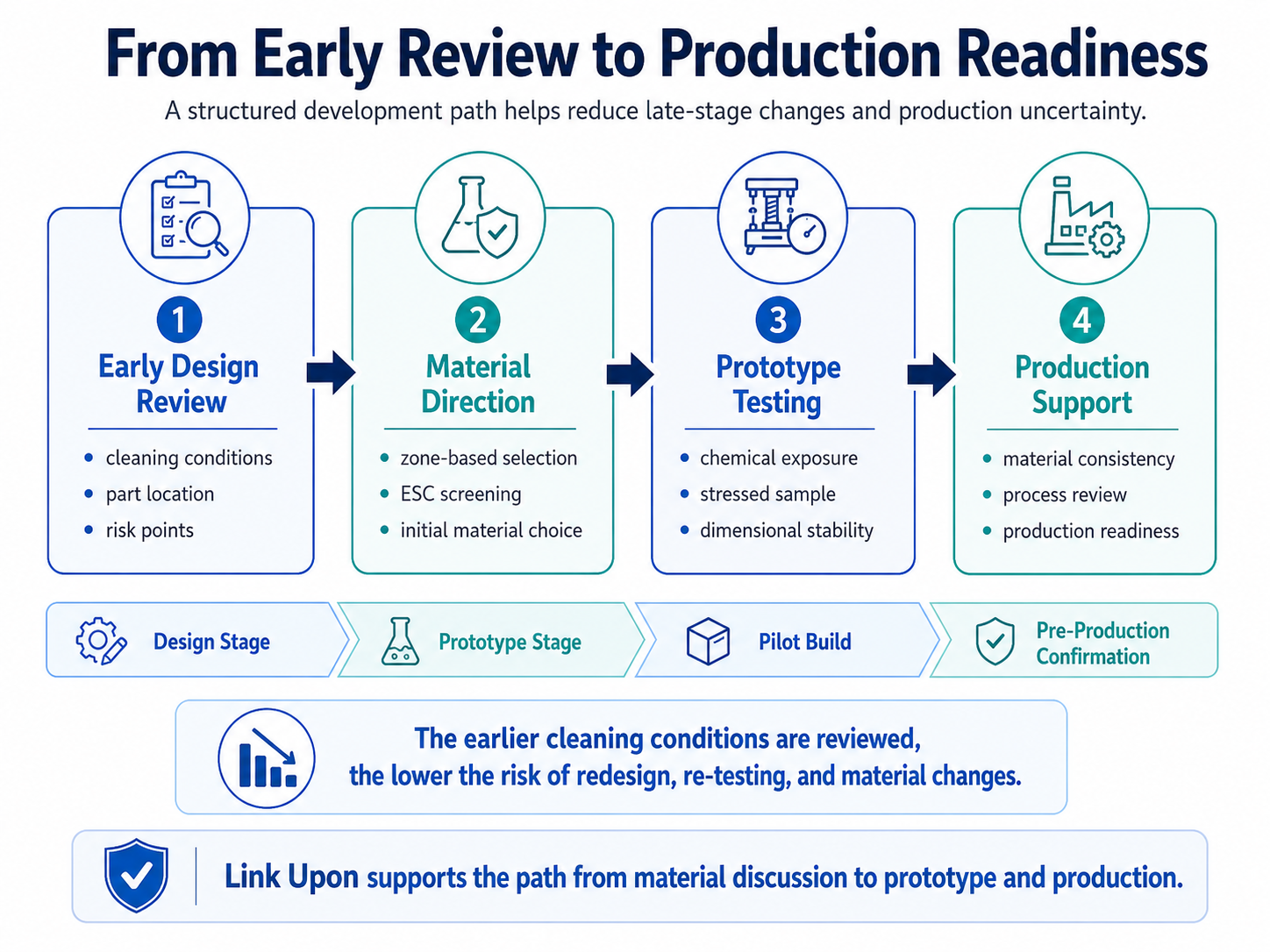
4. From Early Evaluation to Production: A Complete Path to Reducing Uncertainty
At different stages of equipment development, the timing of material selection and validation directly affects final development efficiency:
| Development Stage | Recommended Involvement | Effect on Reducing Uncertainty |
|---|---|---|
| Early design stage | Confirm cleaning conditions, zone-based material logic, and ESC high-risk locations | Helps avoid late-stage redesign of part geometry or material changes due to material mismatch |
| Prototyping stage | Conduct stressed soaking tests using actual cleaning fluid, temperature, and exposure time | Confirms that the material direction has been tested under conditions close to real use before production |
| Pilot build | Confirm how injection molding or CNC machining may affect residual stress in the component | Process differences, such as residual stress and shrinkage, may amplify ESC risk and should be confirmed before production |
| Pre-production confirmation | Confirm consistency between production parts and validated samples in material, geometry, and appearance | Allows customer validation conclusions to carry over to production batches without repeated evaluation |
The core logic of this path is simple: investing time early in development to confirm cleaning conditions and material direction costs far less than discovering during late-stage prototyping or production validation that the material needs to be changed. Link Upon can support each stage of this path - from material selection discussions and prototype samples to production process confirmation - so material selection becomes not only a starting point, but a continuous confirmation process throughout development.
Conditional Material Selection Quick Reference: Finding Material Direction by Use Conditions
The following quick reference table shows common use conditions and material directions in cleaning / disinfection environments. For new development requests, it can help both sides quickly screen application conditions and material directions, keeping discussions focused on the right material range from the beginning and accelerating development.
| Use Condition | Materials to Prioritize for Evaluation | Material and Process Evaluation Focus |
|---|---|---|
| General low-temperature acids / alkalis / cleaning fluids | PP, PVDF | Confirm media concentration, temperature, exposure time, and whether residue may remain |
| Harsher chemical environments (strong oxidizers, strong acids / alkalis) | PFA / PTFE, PVDF, PEEK | Evaluate mechanical strength, creep, fastening method, and processing feasibility together |
| High temperature + strength requirements (>80°C) | PEEK, PPS | Confirm chemical compatibility, long-term stress, fastening-load retention, and dimensional stability |
| Non-chemical-contact sliding / guiding (dry zones) | POM, Nylon | Recommended for dry or medium-to-low-risk mechanical locations; avoid long-term humid-heat or strong oxidizing environments |
| Insulation + dimensional stability | PEI, PPS, PEEK | Reconfirm based on chemical environment, temperature, and component load condition |
| High stiffness + lightweight design | PEEK, PPS GF, RENY | Confirm humid-heat conditions, chemical conditions, and the effect of glass-fiber filling on chemical compatibility |
| Wet-zone fastening / insulation parts | PVDF, PPS, PEEK | Evaluate humidity, temperature, fastening stress, and long-term dimensional stability together |
| Dry mechanical components in dialysis equipment | POM, PP, PPS, PEEK | Confirm based on whether the part contacts liquid, is cleaned, experiences friction, and how often it is assembled / disassembled |
| Around dialysate / cleaning fluids | PP, PVDF, PFA / PTFE, PEEK, PPS | Confirm contact media, concentration, temperature, time, load, and process conditions |

Material Knowledge Serves Component Development - That Is the Core of Our Work
This article discusses many material characteristics and ESC mechanisms, but we want to make one point clear: Link Upon is a manufacturer of high-performance engineering plastic components. We discuss material selection in depth because material decisions directly affect the quality, development efficiency, and production stability of every component we manufacture for customers. A screw, washer, or spacer made from the wrong material for its application environment can affect not only the component itself, but also the validation schedule and launch plan of the entire device.
In cleaning and disinfection environments, the core question is not "Which material is the best?" It is: for this specific component location, this medium, this temperature, and this stress condition, which material is most suitable for producing the component you need - and how can we translate these conditions into an executable process strategy early in development?
The earlier cleaning conditions, component location, ESC risk points, and assembly stress are included in component development discussions, the more likely development testing can start in the right direction - reducing mid-development changes and lowering the risk of discovering material mismatch only after entering production validation.
Selecting Engineering Plastic Components for Cleaning, Disinfection, or Humid-Heat Environments?
Cleaning-fluid type, concentration, temperature, exposure time, and assembly method can all affect long-term material performance in actual equipment. Link Upon can help translate these conditions into comparable material and process directions, evaluate the suitability of PEEK, PPS, PVDF, PFA / PTFE, PEI, and other materials for different component locations, and support prototype samples, molding, and custom production development.
Not sure which material direction fits your application? We can start by discussing the cleaning conditions and component location. Please share your drawing, sample, or application conditions. If cleaning fluids or disinfectants are involved, we recommend also providing the fluid type, concentration, temperature, and exposure time so we can support an initial material evaluation.
Technical Sources
This article is intended as an application-oriented material selection guide for engineering plastics. The discussion of ESC mechanisms and material structure is based on Solvay KetaSpire® PEEK Technical Data Sheet & Design Guide; Victrex PEEK Properties and Chemical Resistance; Kureha KF Polymer® PVDF / Arkema KYNAR® PVDF chemical compatibility technical documents; Celanese Fortron® PPS Technical Data; DuPont Delrin® POM Technical Guide; publicly available ESC technical information from Plastics Technology (SPE); and C-F bond energy values from the NIST CCCBDB bond energy database (C-F ≈ 485 kJ/mol). The cleaning-fluid chemical compatibility quick reference table is compiled from publicly available technical documents from the above material suppliers. Prototype testing recommendations are based on the validation principles of the ISO 10993 series and common engineering validation practices, and do not represent regulatory certification requirements. Actual material suitability should still be confirmed according to the customer's device design, media conditions, regulatory requirements, and validation results.
Disclaimer
This article is intended to provide preliminary reference for material and application direction. It is not intended to serve as a medical device regulatory document, material certification, or final design validation basis. Actual material suitability should be confirmed according to the device design, operating environment, regulatory requirements, and customer validation results.
Series Guide
This three-part series approaches engineering plastic component selection in medical equipment from different angles:
- Blog 1:
Engineering Plastic Fluidic Components in IVD and Medical Analytical Instruments - From Material Compatibility to Sealing Reliability (fluidic fittings, ferrules, nuts, and custom components around fluid paths) - View Blog
- Blog 2:
- Non-Metallic Fasteners and Engineering Plastic Mechanical Components Inside Medical Equipment - From Precision Motion and MRI Non-Magnetic Fastening to Radiolucency Applications (insulating fasteners, MRI-adjacent areas, image-guided surgery, and radiotherapy equipment)
- View Blog Part 1 View Blog Part 2
- Blog 3:
- This Article - Material Selection for Engineering Plastic Components in Cleaning and Disinfection Environments: ESC Risk Assessment x Cleaning-Condition-Driven Material Selection x Real-World Prototyping & Verification
- View Blog Part 1 View Blog Part 2
If your application involves both fluidic sealing and cleaning / disinfection requirements, the selection logic in Blog 1 and Blog 3 can be reviewed together. If the equipment involves both internal mechanical fastening and cleaning environments, the zone-based selection logic in Blog 2 and Blog 3 can be cross-referenced.
