
Link Upon is a manufacturer of high-performance engineering plastic components and fasteners. In this article, we share how we help customers develop components used around cleaning, disinfection, and humid-heat environments - by translating cleaning conditions into material and process decisions, and by showing how these decisions can affect development efficiency and production stability.
In medical equipment, IVD systems, dialysis equipment, and laboratory analytical instruments, many engineering plastic components do not directly contact the human body or samples. However, they may be located for long periods near cleaning fluids, disinfectants, humidity, hot water, temperature changes, or maintenance and service areas.
These components often perform normally during initial assembly or short-term testing. The issue is not always that the material is not advanced enough; rather, the actual cleaning conditions, part location, and assembly method may not have been considered together during material selection. The earlier these conditions are included in development-stage evaluation, the lower the likelihood of repeated prototype direction changes - and the lower the risk of discovering material mismatch only after moving into production validation.
The purpose of this article is not to label any material as "bad." Instead, it focuses on what factors and mechanisms can affect the long-term reliability of engineering plastic components in cleaning, disinfection, and humid-heat environments - and how we translate these factors into practical material selection and development strategies at the early stage of a customer project.
ESC (Environmental Stress Cracking): The Risk Most Likely to Surface Late in Development
In material selection for cleaning and disinfection environments, one of the most important mechanisms to evaluate early is environmental stress cracking, or ESC.
The characteristic of ESC is that a component may look acceptable under chemical immersion alone, or under mechanical stress alone. However, when chemicals, stress, and time are present together, the material may crack or lose performance at conditions far below its mechanical strength limit. This is why some components may pass short-term testing, or even initial use, but show problems only after long-term operation or more aggressive cleaning cycles.
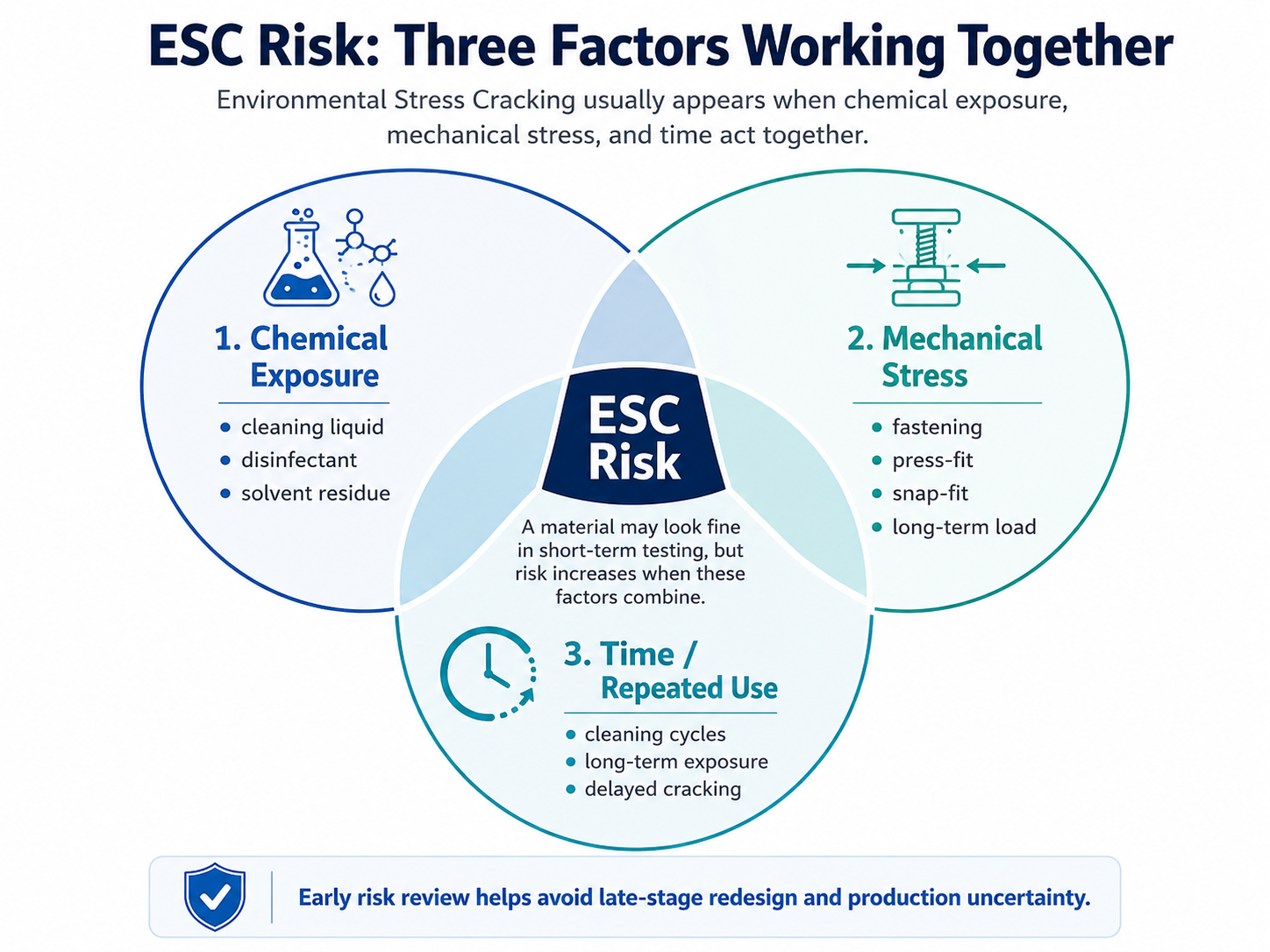
Three Necessary Conditions for ESC
ESC occurs when three factors are present at the same time:
Sensitive material
Not all plastics are equally prone to ESC. Materials with lower crystallinity, lower molecular weight, or residual stress generally carry higher risk.
Chemical environment
Certain cleaning fluids, disinfectants, or solvents can reduce surface energy and promote crack initiation and growth - even when the material appears to have acceptable "static compatibility" with the chemical.
Mechanical stress
Stress may come from fastening, press-fit, snap-fit deformation, welding residual stress, or internal residual stress in locations under long-term load.
If one of these three conditions is missing, ESC usually does not occur. When all three exist together, the speed and severity of ESC can vary significantly depending on the intensity of the conditions. A supplier's static chemical compatibility chart usually cannot serve as the final material selection conclusion by itself, because it only answers one part of the condition set.
That is why, when we receive a component development request involving a cleaning environment, we proactively ask about the cleaning fluid type, concentration, temperature, and fastening conditions - not only the part dimensions and tolerances. Material selection, part geometry, and assembly method need to be evaluated together so the development direction starts in the right place.
Which Material x Cleaning Media Combinations Carry Higher ESC Risk?
The following are relatively common high-risk combinations in medical equipment that are also documented in technical literature. When we receive a component request involving a cleaning environment, we use this type of information for early risk identification, helping customers understand which material-media combinations should be checked first instead of discovering the issue only after prototyping.
| Material | High-Risk Media | Common Failure Locations | Notes |
|---|---|---|---|
| PP (Polypropylene) | Strong oxidizers, such as sodium hypochlorite solution; certain concentrations of organic acids | Thread roots, thin walls, fastening areas | The ESC sensitivity of PP in oxidizing cleaning solutions has been documented. Oxidizing media may promote chain scission and surface cracking in PP. |
| Nylon (PA) | Strong acids, strong alkalis, certain alcohol solutions | Mating surfaces after moisture absorption and swelling; threaded areas | Nylon has high moisture absorption. Dimensional changes after water absorption may accelerate ESC in areas under assembly stress. Long-term reliability may be limited in humid + acidic / alkaline environments. |
| PC (Polycarbonate) | Alcohols such as IPA and ethanol; alkaline cleaning solutions; certain disinfectants | Transparent covers, thin-wall parts, snap-fit areas | PC's ESC sensitivity to alcohol-containing solvents and alkaline cleaning fluids is well known in industry. IPA wiping alone may cause surface crazing. |
| PVDF | Strong reducing agents; certain amine-based solutions | High-temperature + harsh chemical combined environments | PVDF generally performs well with most oxidizing cleaning solutions. However, long-term compatibility should be confirmed under strong reducing agents or special amine-based environments. |
| POM (Polyacetal) | Strong acids, strong oxidizers, long-term high-temperature humid conditions | Threads, snap-fits, press-fit areas | POM may undergo hydrolysis in strong acids or oxidizing agents. It is recommended for dry or low-risk mechanical locations and is not recommended for long-term chemical liquid exposure. |
Materials with Stronger ESC Resistance - and Why
Among engineering plastics commonly used in medical equipment, PEEK and PVDF generally show stronger resistance to ESC. The reason can be understood from their material structure:
- PEEK: As a semi-crystalline material, PEEK's higher crystallinity creates a tighter molecular-chain arrangement, making it more difficult for chemicals to penetrate amorphous regions and promote crack growth. In addition, PEEK's aromatic backbone provides high bond energy, making it less susceptible to attack by common cleaning fluids or disinfectants.
- PVDF: The high bond energy of its fluorocarbon backbone gives PVDF good chemical inertness toward strong oxidizers, such as sodium hypochlorite, and acidic media. However, strong reducing agents and special amine-based solvents still require application-specific confirmation.
- PPS: With high crystallinity and an aromatic sulfide backbone, PPS shows good resistance to most acids, alkalis, organic solvents, and cleaning fluids, while also maintaining mechanical strength at elevated temperatures. It is suitable for positions requiring both heat resistance and chemical resistance.
Understanding the structural reasons behind ESC resistance helps create a more evidence-based material comparison when facing new cleaning media or stricter disinfection conditions - instead of simply ranking materials by grade. When helping customers evaluate components used in cleaning environments, we combine these material characteristics with the part's load-bearing location and geometry to discuss the most suitable material and process direction.
High-Risk Locations for ESC: What Should Be Checked First?
When performing ESC risk evaluation early in development, the following locations should be checked first:
- Thread roots and fastening areas: Thread roots are stress concentration points. Combined with residual stress from fastening torque, they are among the most common starting points for ESC.
- Sharp corners, thin walls, and wall-thickness transitions: These areas may contain higher residual stress from molding and are more likely to crack when exposed to chemicals.
- Snap-fit, press-fit, and interference-fit areas: Long-term elastic deformation stress combined with a chemical environment is a typical trigger condition for ESC.
- Near weld lines: Weld-line areas in injection-molded parts have weaker molecular-chain alignment and can become potential weak points for ESC.
- Washer / spacer locations under long-term compression: Continuous compressive stress plus chemical contact may accelerate creep and ESC at the same time.
Cleaning Fluid x Material Resistance Overview: Our Initial Screening Work
The following overview summarizes the initial resistance tendencies of major engineering plastics against common cleaning and disinfection agents used in medical equipment. When we receive a customer request for component development, this table helps screen material options early in the discussion. By identifying which materials are worth deeper evaluation and which should be avoided, the project can move forward with a clearer material direction before prototyping begins..
| Cleaning / Disinfection Agent | PEEK | PVDF | PPS | PFA / PTFE | PP | POM | Nylon |
|---|---|---|---|---|---|---|---|
| Sodium hypochlorite (NaOCl) (bleach / chlorine disinfectant) | ✓ Good | ✓ Good | ✓ Good | ✓ Good | △ Check conc./temp. | ✗ Not rec. | ✗ Not rec. |
| Sodium hydroxide (NaOH) (alkaline cleaner) | ✓ Good | ✓ Good | ✓ Good | ✓ Good | △ Check conc. | ✗ Not rec. long-term | ✗ Not rec. |
| Isopropyl alcohol (IPA) / ethanol | ✓ Good | ✓ Good | ✓ Good | ✓ Good | ✓ Good | △ Check conc. | △ Check |
| Hydrogen peroxide (H2O2) | ✓ Good | ✓ Good | ✓ Good | ✓ Good | △ Check conc./temp. | ✗ Not rec. | ✗ Not rec. |
| Peracetic acid (PAA) | ✓ Good | ✓ Good | △ Check | ✓ Good | △ Check | ✗ Not rec. | ✗ Not rec. |
| Glutaraldehyde solution | ✓ Good | ✓ Good | ✓ Good | ✓ Good | △ Check | △ Check | △ Check |
| Inorganic acids (phosphoric / hydrochloric acid) | ✓ Good (except strong H2SO4) | ✓ Good | ✓ Good | ✓ Good | △ Check conc. | ✗ Not rec. | ✗ Not rec. |
| RO water / DI water (long-term contact) | ✓ Good | ✓ Good | ✓ Good | ✓ Good | ✓ Good | ✓ Good (dry zone) | △ Watch moisture absorption |
△ = Further confirmation is required based on concentration, temperature, exposure time, and stress conditions
✗ = Generally not recommended for long-term contact with this medium.
This table is an initial screening reference and does not represent any certification or final material selection conclusion. Actual compatibility should still be confirmed according to media concentration, temperature, exposure time, part geometry, assembly stress, and device validation conditions.
Reference sources: chemical compatibility technical documents from major material suppliers such as Solvay KetaSpire® PEEK, Victrex PEEK, Kureha PVDF, Celanese PPS, and DuPont POM; Arkema KYNAR® PVDF chemical compatibility information.
Different Equipment Zones, Different Selection Conditions: Zone-Based Material Logic
A cleaning and disinfection environment does not mean every component must use PEEK or another high-end material. A more practical approach is to build a zone-based material selection logic according to the actual exposure conditions of each component location - using the right material in higher-risk positions and avoiding over-design in lower-risk locations.
| Application Location | Possible Components | Material Direction | Material Selection Evaluation Focus |
|---|---|---|---|
| Cleaning module fasteners | Screws, nuts, washers | PVDF, PP, PEEK, PPS | Cleaning-fluid contact, humidity, temperature, and fastening stress conditions |
| Supports around chemical liquids | Spacers, standoffs, brackets | PVDF, PFA / PTFE, PP | Media type, concentration, exposure time, dimensional stability |
| Serviceable / replaceable structures | Screws, knobs, bushings | POM, PP, PEEK | Disassembly frequency, thread wear, torque retention (use POM only in dry or low chemical-exposure locations) |
| Wet-zone insulating parts | Insulating sleeves, washers | PVDF, PPS, PEEK | Humidity, chemical residue, insulation requirements, long-term dimensional stability |
| Around reagent or cleaning-fluid residue | Custom components, fixtures | PFA / PTFE, PVDF, PEEK | Residual media type, exposure time, component load condition |
| Heating / temperature-control areas | Screws, spacers, washers | PEEK, PPS, PEI | Heat resistance, creep, fastening-load retention, dimensional stability |
| Around dialysate supply systems | Washers, brackets, fasteners, custom components | PP, PVDF, PPS, PEEK | Dialysate, RO water, cleaning process, maintenance / disassembly conditions |
| Endoscope cleaning / disinfection equipment | Screws, brackets, fluid-path holders | PVDF, PFA / PTFE, PP, PEEK | Disinfectant type, wet exposure time, temperature, and fastening method |
Dialysis Equipment Example: Dry Mechanical Zones and Wet Zones Should Not Follow the Same Material Logic
Inside a hemodialysis device, dry mechanical zones, dialysate / RO water contact areas, cleaning-fluid residue areas, and maintenance / replaceable structures may all coexist. In this type of device, POM may be considered for certain dry mechanical components, such as rollers, hinge spacers, or washers in low chemical-exposure areas. However, if a component is located near the dialysate supply path, disinfection circulation lines, or cleaning-fluid residue areas, PP, PVDF, PFA / PTFE, PEEK, or PPS should be evaluated, with temperature, exposure time, and assembly stress also confirmed.
This example shows the core value of zone-based material selection: the goal is not to upgrade the entire system to high-end materials, but to make sure each material choice is supported by the conditions of its specific location. This is why, when supporting component development for dialysis equipment or similar multi-zone devices, we proactively help customers clarify the actual exposure conditions of each component position instead of simply offering one generic material recommendation.
