
From Non-Magnetic to Ultra-Low-Interference Design: Engineering Plastic Components in Medical Imaging Equipment
In 1.5T and 3.0T medical imaging equipment, and even in advanced 7.0T research environments, image resolution and signal stability are key competitive factors in high-end equipment design. Fastener selection has also evolved beyond a simple fastening function and has become part of material design for reducing interference, maintaining signal integrity, and supporting equipment safety.
Traditional non-magnetic metals such as brass and titanium alloy can reduce magnetic concerns, but metal still has electrical conductivity and X-ray shielding effects. In certain equipment locations, this may create concerns related to imaging artifacts, signal interference, or radiation attenuation. High-performance engineering plastics such as PEEK, PEI, and PPS offer non-magnetic, electrically insulating, and lower X-ray shielding characteristics, providing lower-interference fastening solutions for imaging paths and signal-sensitive areas.
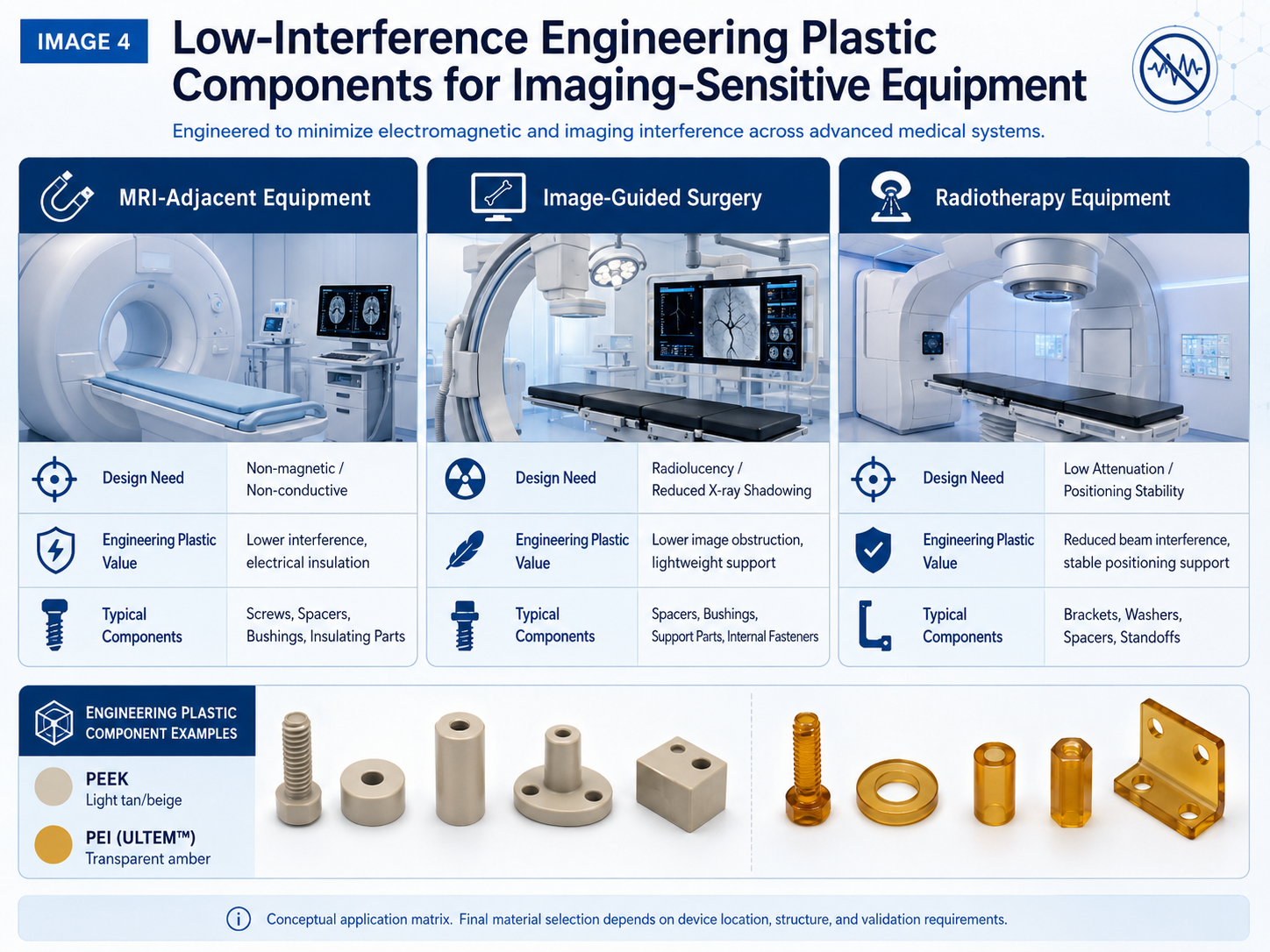
MRI-Adjacent Equipment: Design Considerations for Dual Isolation - Non-Magnetic + Electrically Insulating
High-performance engineering plastics such as PEEK and PEI are non-metallic, non-magnetic, and electrically insulating, making them relatively friendly material options for MR Safe design considerations. Compared with metal fasteners, these engineering plastic components help reduce concerns related to electrical conduction, magnetic interference, and imaging artifacts, making them suitable for fastening, support, and insulation locations around MRI-adjacent and signal-sensitive equipment.
One technical detail is worth highlighting: titanium alloy fasteners commonly used in MRI equipment have very low magnetic susceptibility, which can greatly reduce safety risks and imaging artifacts caused by attraction in strong magnetic fields. However, titanium alloy remains electrically conductive. Around RF coils, signal-sensitive modules, or locations where additional conductive metal paths are undesirable, metal conductivity may introduce concerns such as RF signal interference, eddy currents, or localized heating.
For these applications, PEEK, PEI, and other engineering plastics offer a dual-isolation advantage by combining non-magnetic behavior with electrical insulation. This helps reduce both magnetic and electrical interference risks, making them a more suitable low-interference fastening option in locations where both properties are required.
Image-Guided Surgical Systems: Reducing Metal Obstruction to Support Image Interpretation
In surgical environments that use C-arm or X-ray image guidance, selecting PEEK, PEI, and similar engineering plastics for non-contact joints, internal fasteners, bushings, spacers, or support components around the instrument front end can help reduce image obstruction and artifacts caused by metal. This supports clearer image interpretation and more reliable positioning support.
Engineering plastics such as PEEK and PEI are mainly composed of low-atomic-number elements, including carbon (C), hydrogen (H), oxygen (O), and nitrogen (N). Compared with high-atomic-number metals such as iron, cobalt, and chromium, these materials generally have much lower X-ray mass attenuation coefficients. As a result, they tend to cause less X-ray attenuation in imaging paths, making them suitable for non-contact support, fastening, and guiding locations where metal interference needs to be reduced.
Radiotherapy Equipment: Physical Basis and Applications of Low Radiation Attenuation
In radiotherapy equipment, component materials do more than provide structural support. They can also affect image-guided positioning and dose calculation. When small metal components are located in the radiation path, patient positioning devices, or around collimator assemblies, increased absorption and scattering may interfere with positioning image interpretation, dose calculation, and system stability.
High-performance engineering plastics such as PEEK and PEI generally offer lower radiation attenuation than stainless steel and other metals. This can help reduce image interference and metal-related artifacts, while also supporting lightweight, dimensionally stable, and non-metallic component designs. For applications that require both structural support and radiotherapy compatibility, these materials provide additional design flexibility.
In selected radiotherapy equipment and patient positioning systems, engineering plastic fasteners, washers, and support components can therefore serve as practical alternatives to metal parts in locations where lower interference is required. They give equipment designers more options for fastening, positioning, and support structures without introducing unnecessary metal into sensitive areas.
Brief Overview of Material Roles
The following overview summarizes the functional positioning of key materials used in internal mechanical components for medical equipment, providing engineers with a quick reference for zone-based material selection:
PEEK
Suitable for locations requiring high strength, high heat resistance, dimensional stability, non-magnetic properties, and radiolucency, such as screws, spacers, bushings, and front-end support components around medical imaging equipment. PEEK can reach a continuous use temperature of approximately 250°C and offers excellent chemical compatibility with many organic solvents, inorganic acids, and alkalis. Strong oxidizing environments such as concentrated sulfuric acid still require condition-specific confirmation.
PEI (ULTEM™)
Suitable for locations requiring electrical insulation, dimensional stability, heat resistance, and low radiation attenuation, such as sensor brackets, fixture components, radiotherapy supports, and MRI-adjacent standoffs. PEI has high dielectric strength, excellent dimensional stability, and can withstand autoclave conditions, making it suitable for internal equipment locations requiring repeated cleaning and disinfection.
PPS
Suitable for structural fasteners, washers, spacers, and supports that require dimensional stability, heat resistance, chemical resistance, and production scalability. PPS has high crystallinity, strong chemical inertness, and good dimensional stability, making it a practical option that balances performance and injection-molding production efficiency.
PVDF / PFA / PTFE
Suitable for wet areas, chemical fluid surroundings, or cleaning-environment-related components. Selection should be confirmed according to media, concentration, temperature, and exposure time. PVDF offers better resistance to strong oxidizing cleaning solutions such as sodium hypochlorite. PFA / PTFE are among the most chemically inert options and are suitable for areas with extremely high chemical exposure, but their mechanical strength is relatively lower and should be evaluated according to part geometry and load conditions.
POM / Nylon
Can be used in dry-area or low- to medium-risk mechanical locations, such as rollers, guide parts, bushings, washers, and hinge spacers. POM offers a low coefficient of friction and high dimensional precision. Nylon (PA) has good wear resistance, but it has high moisture absorption and reduced dimensional stability in humid environments; it is not recommended for direct use in high-temperature, strongly chemical, or long-term wet environments.
Common Material Selection FAQ
Q1: Does non-metallic automatically mean MR Safe?
Engineering plastics such as PEEK, PEI, and PPS are non-magnetic and non-conductive, making them relatively friendly material options for MRI environments. However, using engineering plastic components does not mean the entire assembly or device has obtained MR Safe labeling. MR Safe / MR Conditional labeling is based on applicable regulatory standards and requires systematic evaluation and validation of the complete assembly, including all materials, geometry, and connected parts. It cannot be claimed based only on the material of a single component.
Q2: Can PEEK be used directly in the radiotherapy beam path?
PEEK's low-atomic-number composition does provide lower radiation attenuation. However, whether it can be used in a specific application still depends on part geometry and thickness, since even a low-attenuation material can attenuate radiation if it is sufficiently thick; the exact part location in the radiation path; and its impact on dose calculation in the treatment plan. These factors should be jointly evaluated by the equipment design engineer and the medical physicist. Engineering plastic material properties are the starting point for evaluation, not the final conclusion.
Q3: If POM can be used for rollers in dialysis equipment, why not use higher-end PEEK?
In sliding mechanism locations that are dry, not exposed to high temperature, and free from strong chemical exposure, POM's low coefficient of friction, good dimensional precision, and lower material cost often make it a better fit than PEEK. The goal for equipment designers is not to choose the most advanced material, but to choose the most suitable material for a specific location. If the application involves disinfectant exposure or higher temperature, upgrading to PEEK or PPS can then be evaluated.
Q4: Which process is suitable for engineering plastic medical components: CNC machining or injection molding?
Both processes have their own suitable applications. CNC machining is suitable for low-volume, high-mix production, tight dimensional requirements, and prototype needs during the development and validation stage. It also offers flexible material selection because PEEK, PEI, POM, and other materials can be machined directly from rod or plate stock. Injection molding is more suitable for stable high-volume production, where tooling costs can be amortized over larger production quantities.
Small Components Supporting the Reliable Operation of High-Precision Medical Equipment
In high-end medical equipment, many critical performance differences do not come only from the main system. They can also come from internal fasteners, washers, bushings, spacers, and small mechanical components. Although these parts are small, they may affect assembly stability, operating precision, signal quality, image interference control, and long-term reliability.
The value of engineering plastic components is not simply to replace metal. It is to solve limitations that metal cannot easily overcome in specific locations, such as electrical conduction, magnetic interference, radiation shielding, friction and wear, weight, and corrosion risk. From POM rollers and washers in dialysis equipment, to bushings and spacers around precision gear pumps; from dual-isolation fastening around MRI systems with non-magnetic and non-conductive properties, to low-interference PEEK / PEI components in image-guided surgery and radiotherapy equipment, the real key is selecting the right material for the application location so that small components can become part of the reliability foundation of medical equipment.
Need non-metallic fasteners or custom mechanical components for medical equipment?
Link Upon can help evaluate suitable engineering plastic materials and processing methods based on your application location, functional requirements, and operating environment. We support the full development process from drawing review and CNC prototype samples to tooling development and production manufacturing.
Not sure which material or process is right for your equipment? We can start by discussing your application conditions. Share your drawing, sample, or application requirements with us to discuss your custom engineering plastic component needs.
Contact UsTechnical Sources
This article is intended as an application-oriented material selection guide for engineering plastic fasteners and mechanical components. The discussion is based on publicly available material property data, engineering plastic technical information, medical imaging material application information, and Link Upon's application experience in engineering plastic fasteners and custom components. Representative sources include: Solvay KetaSpire® PEEK Technical Data Sheet / Design Guide; Victrex PEEK Properties and Technical Information; SABIC ULTEM™ PEI Technical Data; Kureha KF Polymer® PVDF Technical Data; technical data from PPS / POM / Nylon material suppliers; NIST XCOM Photon Cross Sections Database; ASTM F2503 Standard Practice for Marking Medical Devices and Other Items for Safety in the Magnetic Resonance Environment; publicly available technical information on PEEK radiolucency / medical imaging compatibility; and dry sliding friction coefficient information for POM from DuPont Delrin® / Celanese Hostaform® technical documents. For applications involving MRI, MR Safe / MR Conditional labeling, image guidance, or radiotherapy equipment, final suitability should still be confirmed according to the equipment design, part location, thickness, geometry, radiation energy, regulatory requirements, and customer validation results.
Disclaimer
This article is intended to provide general reference for material and application direction. It is not intended to serve as a medical device regulatory document, material certification, or final design validation basis. Final material suitability should be confirmed according to the actual device design, operating environment, regulatory requirements, and customer validation results.
Further Reading | Preview of the Next Article
Engineering plastic components inside medical equipment can provide value in insulation, non-magnetic fastening, radiolucency, low-friction motion, and mechanical support. However, when components are located near cleaning fluids, disinfectants, humidity, temperature changes, or long-term chemical exposure, material selection also needs to consider chemical compatibility and environmental stress cracking risks. In the next article, we will discuss: Material Selection for Engineering Plastic Components in Cleaning and Disinfection Environments: ESC Risk Assessment x Cleaning-Condition-Driven Material Selection x Real-World Prototyping & Verification.
