
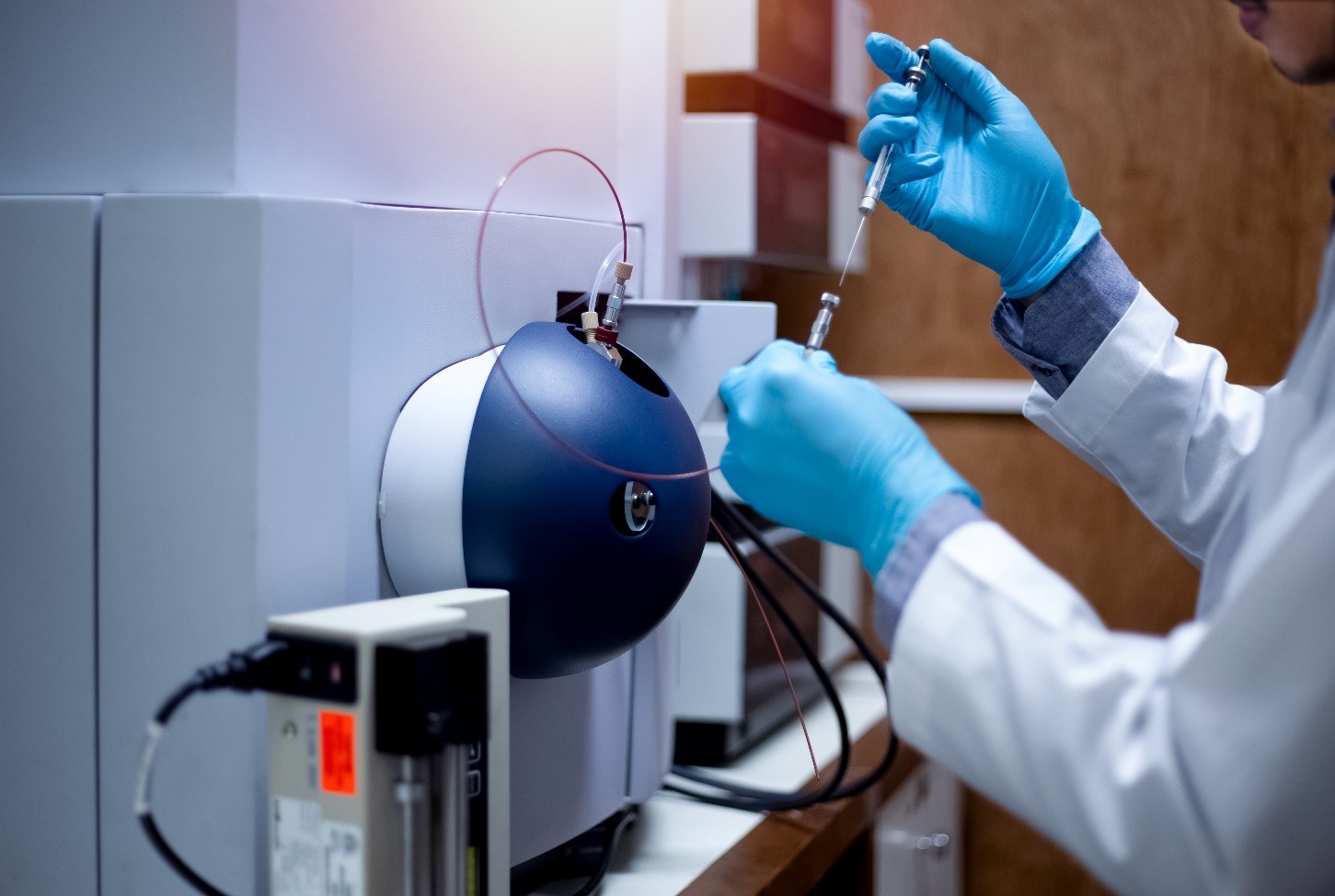
In IVD (in vitro diagnostics) and various medical analytical instruments, system stability depends not only on pumps, valves, or sensors, but also on many small fluidic components.
Examples include PEEK fittings, ferrules, fingertight nuts, washers, spacers, tubing supports, and custom peripheral components for fluidic systems. Although these parts are small, they may affect fluidic sealing, chemical compatibility, assembly stability, and long-term reliability.
When equipment repeatedly handles samples, reagents, buffers, cleaning solutions, or waste fluids, evaluating component materials and structural design early in development according to actual operating conditions can help improve fluidic sealing, assembly stability, and long-term reliability.
Why Should IVD and Medical Analytical Instruments Pay Attention to Small Fluidic Components?
IVD, HPLC, LC, and medical analytical equipment are highly integrated precision fluidic systems. Inside these systems, samples, reagents, buffers, cleaning solutions, and waste fluids may pass through tubing, fittings, pumps, valves, and various support or mounting components.
Even small fittings, ferrules, washers, or spacers can affect fluidic sealing, chemical compatibility, assembly stability, and long-term reliability. Common risks are not always obvious breakage. They may also include:
Leakage
Minor leakage may occur at sealing contact surfaces after repeated thermal cycling or under assembly stress.
Reduced sealing performance
Ferrules or washers may lose their initial sealing force after long-term compression and chemical exposure.
Loosening at fastening points
Dimensional creep may cause threaded connections to relax over time.
Changes in fit after cleaning
Certain materials may absorb moisture, swell, or develop microcracks after exposure to specific cleaning solutions.
Application Example: The Cost of Fluidic Sealing Failure in High-Throughput IVD Equipment
Take a high-throughput biochemical analyzer as an example. The equipment may perform hundreds to thousands of precise sample and reagent dispensing cycles per day. The fluidic path may involve various buffers, cleaning solutions such as NaOH or sodium hypochlorite, and acidic reagents, while each test requires strict quantitative accuracy.
In this type of environment, minor leakage at a fluidic fitting or ferrule can trigger a chain of issues:
- • Reagent cross-contamination, causing quantitative results to drift or repeatability to decline, which directly affects the accuracy of test reports.
- • Cleaning solution residue, especially when the fitting material does not have sufficient chemical resistance to high-concentration NaOH, may lead to microcracking after repeated cleaning cycles and eventually cause sealing failure.
- • Unexpected downtime, as fitting replacement requires equipment shutdown and maintenance, which can be costly in clinical laboratories or high-throughput screening environments.
For this reason, evaluating the material compatibility and assembly method of fittings, ferrules, and sealing components during the fluidic design stage is far more cost-effective than making corrective changes after the equipment is already in use.
Application Areas and Material Selection for Engineering Plastic Fluidic Components
In IVD, HPLC / LC, and medical analytical equipment, engineering plastic components are commonly used in fluidic fittings, reagent and cleaning-solution areas, pump and valve modules, tubing support, and waste-fluid zones. Material requirements vary by location, so selection should be evaluated according to contact media, temperature, pressure, assembly method, and cleaning conditions.
| Application Area | Common Components | Candidate Materials | Selection Focus |
|---|---|---|---|
| Fluidic fittings and connection area | Fittings, ferrules, nuts, connectors | PEEK, PFA / PTFE | Sealing reliability, dimensional stability, chemical resistance, pressure resistance |
| Reagent / cleaning solution area | Washers, mounts, custom components | PVDF, PFA / PTFE, PP, PEEK | Chemical resistance, wet-zone stability, corrosion resistance |
| Pump and valve module area | Screws, nuts, washers, spacers | PEEK, PPS, PVDF | Fastening strength, temperature resistance, chemical resistance, electrical insulation |
| Tubing support and routing (dry area) | Tube clips, mounts, spacers | POM, PP, PVDF, PEEK | Positioning, support, reducing tube movement or wear (POM should be limited to dry, low-chemical- exposure locations) |
| Cleaning / waste-fluid area | Brackets, washers, custom components | PVDF, PP, PFA / PTFE, PEEK | Wet-zone fastening, corrosion resistance around chemical fluids |
| Non-metallic isolation components | Spacers, washers, insulating components | PEEK, PPS, PVDF | Electrical insulation, isolation, preventing metal-to-metal contact |
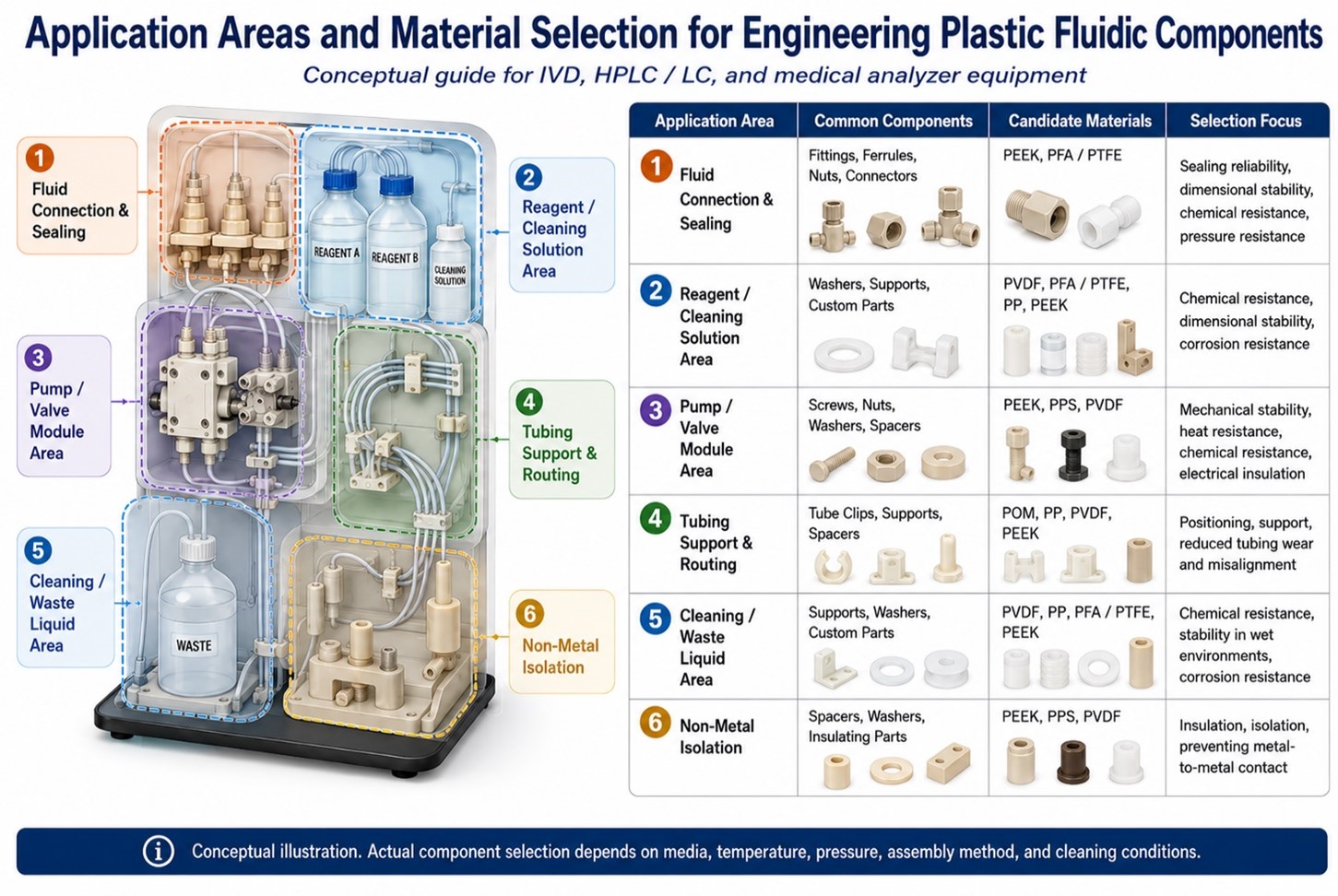
For fittings or precision components that require high mechanical strength and dimensional stability, PEEK can be considered first. For components located around reagents, cleaning solutions, or wet zones, PVDF, PFA / PTFE, PP, or PEEK may be evaluated depending on the conditions. For support, guiding, or low-friction components in dry areas, POM may also be a suitable option.
However, no material should be selected by name alone. Final selection should still be confirmed according to the actual contact fluid, temperature, pressure, cleaning conditions, and assembly method.
Material Selection for Fluidic Components Should Not Be Based on Chemical Resistance Alone
When evaluating fluidic components, chemical resistance is important, but it is not the only factor. In actual applications, component reliability is often influenced by several conditions working together:
- • Fluid type and concentration
- • Operating temperature and thermal cycling
- • Internal system pressure
- • Fastening stress and assembly method
- • Cleaning frequency and cleaning-solution type
- • Long-term operating time
Some materials may appear compatible under short-term, room-temperature, stress-free conditions. However, under long-term exposure, pressure changes, thermal cycling, repeated cleaning, or assembly stress, they may still develop microcracks, reduced sealing performance, dimensional changes, or environmental stress cracking (ESC), which refers to cracking caused by the combined effect of stress and chemical exposure.
Environmental Stress Cracking (ESC): An Often Overlooked Long-Term Failure Mechanism
Environmental Stress Cracking (ESC) occurs when a material cracks earlier under the combined influence of mechanical stress and a chemical environment than it would under stress or chemical exposure alone. In fluidic components, ESC is often seen in situations such as:
- • Residual stress after threaded fastening, combined with long-term immersion of the fitting in a cleaning solution, causing microcracks in the nut or fitting body.
- • Ferrules under compression, where exposure to organic solvents such as alcohol-containing cleaning solutions may accelerate embrittlement.
- • Stress-cracking risks in PP or lower-grade Nylon components exposed to sodium hypochlorite cleaning solutions.
ESC resistance varies significantly among materials. PEEK, with its high crystallinity and chemical inertness, generally provides better ESC resistance in many inorganic acids, bases, and organic solvents. PVDF can perform well in strong oxidizing cleaning solutions such as sodium hypochlorite. POM, while offering good mechanical properties, has more limited chemical compatibility in long-term strong acid or strong oxidizing environments and should generally be limited to dry or low-chemical-exposure locations.
(Specific ESC risks should still be evaluated based on the actual media, concentration, temperature, stress conditions, and exposure time. Material supplier technical documents can serve as an initial reference point for chemical compatibility.)
Common Material Selection Misconceptions FAQ
Q1: PEEK is a high-performance material. Does that mean PEEK is always the safer choice?
PEEK performs very well in high strength, high temperature resistance, dimensional stability, and resistance to many chemicals. However, that does not mean every location should use PEEK. In dry guiding or sliding locations with low chemical exposure, POM may be a better fit because of its low friction and machinability. For applications involving aggressive chemicals or strong oxidizing cleaning agents, PVDF or PFA / PTFE may be more suitable. Material selection should be based on application conditions, not simply on material grade.
Q2: If a material supplier says a material is chemically compatible, can it be used directly?
Material supplier chemical compatibility data is typically based on single-material test results under room-temperature, stress-free, specific-concentration, and limited-immersion conditions. It does not necessarily represent how a finished component will perform under real assembly stress, thermal cycling, mixed media, and long-term service conditions. Reliability assessment should consider material properties, component geometry, assembly method, and the actual operating environment together.
Q3: Nylon has good wear resistance. Can it be used around cleaning solutions?
Nylon (polyamide) provides good wear resistance in dry environments, but it also has high moisture absorption. In humid or long-term liquid-exposure environments, Nylon may undergo dimensional changes due to water absorption and swelling, which can affect sealing fit and assembly stability. In locations exposed to cleaning solutions, especially those containing strong alkalis or strong oxidizing agents, Nylon has relatively limited chemical compatibility and is not recommended as the primary material for fluidic fittings or sealing components.
Q4: Why not use stainless steel directly for fluidic fittings?
Stainless steel fittings are widely used in general fluidic applications. However, when an application needs to avoid metal ion contamination, such as certain biological reagent fluid paths, requires electrical insulation, or needs to reduce metal corrosion risks in the equipment design, engineering plastic fittings provide a non-metallic alternative. PEEK fittings have an established application history in HPLC, IVD, and biochemical analytical instruments, with suppliers such as IDEX Health & Science / Upchurch Scientific offering PEEK HPLC fittings over the long term, making PEEK a practical option for these applications.
Choosing the Right Material Is Only the First Step, Complete Application Evaluation Is the Real Key
For medical analytical equipment manufacturers, what is usually needed is not just a material, but a component solution that fits actual assembly, sealing, production, and maintenance requirements. Whether the component is a PEEK fitting, ferrule, nut, washer, spacer, or a custom peripheral fluidic component made from PFA / PTFE or PP, its value is not limited to replacing metal or providing a single chemical-resistance property. Under the right application conditions, these components can help equipment achieve fluidic stability, reliable sealing, corrosion resistance, electrical insulation, easier assembly, and long-term service reliability.
Link Upon can help customers start from the actual application conditions and discuss material selection direction, drawing review, prototype samples, tooling development, and production planning. Based on the component function, we can help evaluate engineering plastic material options such as PEEK, PPS, PVDF, PFA / PTFE, PP, and POM.
Need fluidic components for IVD, HPLC, or medical analytical instruments?
If you are developing fluidic fittings, sealing components, mounting parts, or custom peripheral fluidic components for IVD, HPLC, LC, or medical analytical instruments, feel free to provide drawings, samples, and operating conditions. Link Upon can help evaluate suitable engineering plastic materials and manufacturing processes based on contact fluids, temperature, pressure, cleaning conditions, and production requirements.
Not sure which material option is suitable for your application? We can start with the operating conditions.
Contact Us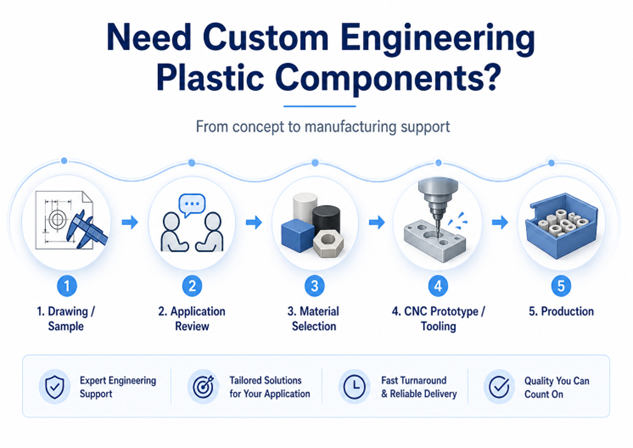
Technical Sources
This article is intended as an application-oriented material selection guide for engineering plastic fluidic components. The discussion is based on publicly available material property data, chemical compatibility information, HPLC / LC fluidic component manufacturer information, and Link Upon's application experience in engineering plastic fasteners and custom components. Representative sources include Solvay KetaSpire® PEEK Technical Data Sheet & Design Guide; Victrex PEEK Properties and Chemical Resistance Information; Kureha KF Polymer® PVDF Technical Data / Chemical Resistance Information; IDEX Health & Science / Upchurch Scientific HPLC fitting materials technical information; and VICI Valco Instruments fluidic component materials data. ESC-related mechanisms are referenced from publicly available Plastics Technology / SPE technical information and material supplier chemical compatibility documents. Final material suitability should still be confirmed according to the customer's device design, media type, concentration, temperature, pressure, exposure time, assembly conditions, and validation results.
Disclaimer
This article is intended as an application-oriented material selection guide for engineering plastic components. It provides an initial reference for material and application direction only and should not be used as medical device regulatory evidence, material certification documentation, or final design validation. Final material suitability should be confirmed according to device design, operating environment, regulatory requirements, and customer validation results.
Further Reading | Next Article
In addition to fluid-control systems, medical and diagnostic equipment also includes many internal areas for electronic control modules, sensors, pumps and valves, motors, cable routing, and mechanical fastening. These areas also require non-metallic, electrically insulating, stable, and production-ready engineering plastic component solutions. If your equipment also involves internal mechanical fastening, such as PCB support, MRI-adjacent non-magnetic fastening, or low-radiation-attenuation components for radiotherapy equipment, you may refer to the second article in this series: Non-Metallic Fasteners and Engineering Plastic Mechanical Components Inside Medical Equipment.
