
When Should Small Parts in PCB and Power Modules Be Re-Evaluated?
In PCB assemblies, power supplies, DC/DC converters, PoE power sections, and telecom power equipment, standoffs, supports, washers, sleeves, bushings, and small screws are rarely the first components discussed. They often serve basic fastening, spacing, or insulation functions—and in many cases, standard parts are exactly the right choice.
PA66 (nylon 66) standard parts are common for good reasons: broad availability, many sizes, reasonable cost, and solid performance in general fastening and insulation positions. When the part is only supporting a housing, carrying a light load, or providing simple spacing, there is usually no reason to overcomplicate the design. But if it sits near a long-term heat source, controls board spacing, participates in an insulation boundary, falls within an ESD-controlled area, or simply does not match an available size, it deserves a closer look earlier in design and sourcing.
1. PA66 (Nylon 66) Standard Parts Are a Practical Starting Point in Many Locations
For general PCB support, enclosure fastening, light-load spacing, or basic insulation, PA66 (nylon 66) standard parts are often sufficient. Their advantages are straightforward: reasonable cost, broad supply, and a wide range of available sizes.
The point is not to replace every small part in a power module with PPS, PEI, or PEEK. It is to understand the role of the part: Is it only fastening or spacing, or does it also have to manage heat, board spacing, an insulation boundary, or an ESD requirement?
2. Conditions Become More Demanding Near Heat Sources and Thermal Hardware
The main heat sources in a power module are typically MOSFETs, power transistors, rectifiers, power ICs, inductors, and transformers. A heat sink is not itself a heat source, but because it receives heat from those components, the area around it can still become a localized high-temperature zone.
Standoffs, washers, sleeves, and supports do not generate heat, but they may sit next to power devices, beside a heat sink, or in a poorly ventilated corner. In those areas, a small part may see a local temperature well above the system average for long periods. If it also carries load, maintains fit, controls board spacing, or provides insulation, its long-term material performance needs to be checked more carefully.
Local temperature is only one factor. When the same part also controls board spacing, contributes to electrical isolation, must meet ESD-control requirements, or sees sliding and wear, the evaluation criteria change again.
3. Different Locations Call for Different Checks
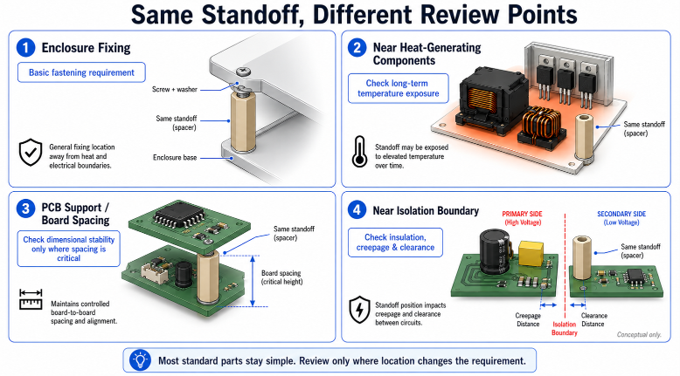
There is no need to assume the material must change. Start by looking at what the part is doing in the module and whether its surroundings are still within the range of ordinary fastening, spacing, or insulation. The table below shows where existing PA66 nylon standard parts are often appropriate and where additional review is warranted.
| Location / Part Role | When PA66 Nylon Standard Parts Are Often Suitable | Conditions That Require Further Review and Next Steps |
|---|---|---|
| General PCB support or enclosure fastening | Low load, ambient temperature, generous dimensional tolerance, and a basic fastening, spacing, or insulation role. | If the part is near heat, inside a hot and humid enclosure, or subject to explicit flammability, load-retention, or long-term dimensional requirements, confirm the actual grade and use conditions first. If needed, compare PA12, PBT, PPS, or other suitable materials. |
| Standoffs / washers near power components or thermal structures | Local temperature is moderate, load is low, and the part does not control a critical dimension or insulation boundary. | If it is near MOSFETs, rectifiers, power ICs, inductors, transformers, or a heat sink and sees long-term heat plus compressive load, verify creep and strength using the actual local temperature, load, and duration. When several requirements increase together, compare PPS, PEI, or PEEK. |
| Board-spacing-sensitive locations | Board spacing and connector alignment have enough tolerance, and humidity-related dimensional change will not affect assembly consistency. | If board spacing, terminal position, or assembly alignment must remain controlled under humidity changes or long-term load, compare the grade’s moisture uptake, post-conditioning dimensional change, and long-term load behavior. PPS, PBT, PEI, or other low-moisture materials may be appropriate. |
| Near insulation boundaries or metal housings | Low-voltage, lower-risk fastening locations with ample clearance and creepage distance. | If the part is near the primary/secondary boundary, a high-current path, metal housing, or grounding structure—and also contributes to spacing or isolation—confirm clearance, creepage, CTI, flammability rating, thickness, and the actual environment against the equipment requirements. |
| Near high-speed ICs or ESD-sensitive areas | General fastening outside an ESD-controlled area when the customer has not specified an ESD or antistatic grade. | If the customer specifies ESD or antistatic material, or the part is used near test sockets, fixtures, or an ESD-sensitive area, confirm surface resistance range, base resin, additive method, process, and test conditions. Do not assume that any plastic part is ESD-safe. |
| Fan bushings, vibration pads, or moving parts in thermal modules | Static fastening, low-frequency vibration isolation, or simple spacing. | If the part functions as a bushing, gear, sliding element, or high-speed moving component and sees long-term friction, wear, and temperature change, shift the evaluation toward friction, wear, lubrication, noise, dimensional stability, and temperature. Wear-grade PA66, POM, or another sliding material may be more suitable. |
The table makes one point clear: equipment type alone does not determine the material direction. In many cases, the deciding factor is the function of the part and the dominant condition—long-term heat and load, moisture-related dimensional change, flammability, wear, or ESD control. Once those conditions are clear, the material comparison becomes much more useful.
4. Identify the Dominant Condition Before Comparing Materials
When a PA66 nylon part needs additional review, the next step is not automatically PEEK. PA12, PBT, PPS, PEI, PEEK, POM, and ESD-rated materials address different needs related to moisture uptake, dimensions, temperature, flammability, wear, and static control.
If the application remains straightforward, keeping the existing PA66 nylon specification is often the most practical choice. Other materials should be compared only when the dominant condition changes. Even within the same polymer family, reinforcement, heat stabilization, flame-retardant packages, and ESD formulations can produce very different part performance.
Material Options by Dominant Condition and Part Function
| Material Direction | Best-Fit Locations | What to Confirm Before Use |
|---|---|---|
| PA66 / Nylon | General PCB fastening, spacing, and insulation in moderate-temperature, straightforward conditions; broad cost, size, and supply options. | Reinforcement, heat stabilization, flammability package, and dimensional behavior after moisture exposure vary widely by grade. Confirm the actual material specification. |
| PA12 / Low-Moisture Nylon | Fastening and support parts where moisture-related dimensional change, toughness, snap-fit performance, repeated assembly, or low-temperature impact are important. | UV stabilization, long-term temperature, stiffness, creep, flammability requirements, and actual grade. Lower moisture uptake does not make PA12 suitable for every high-temperature or outdoor environment. |
| PBT / PBT+GF | Internal mounts, precision supports, connector-adjacent parts, and components that need dimensional stability and electrical insulation. | Hydrolysis risk in hot and humid conditions, impact strength, reinforcement level, and flammability rating. |
| PPS / PPS+GF | Standoffs, washers, sleeves, and supports that require low moisture uptake, dimensional stability, heat resistance, and production consistency. | Impact performance, design stress, glass-fiber content, outdoor/UV conditions, and actual grade properties. |
| PEI | Insulators, supports, and connector-adjacent parts with clear flammability, electrical insulation, and high-temperature dimensional requirements. | Chemical resistance, stress cracking from specific solvents, long-term load, and thickness-dependent flammability performance. |
| PEEK | A limited number of fastening or isolation points where very high local temperature, load, dimensional stability, and long-term reliability requirements overlap. | Necessity, cost, process, fastening design, and actual grade properties. High temperature alone does not automatically require PEEK. |
| POM | Fan bushings, gears, sliding parts, and moving components that need wear resistance, low friction, or low noise. | Not a general solution for high-temperature insulation, flammability, or strong-acid environments. Confirm temperature, chemical exposure, and flammability requirements. |
| ESD / Antistatic Materials | High-speed IC areas, test sockets, fixtures, or any location where the customer explicitly requires static control. | Surface resistance range, base resin, conductive or antistatic additives, process and test conditions, and the effect on mechanical properties and appearance. |
If moisture-related dimensional change is the concern, start with PA12, PBT, or PPS. When heat, flammability, and insulation requirements overlap, compare PPS, PEI, or PEEK. For sliding, wear, and low-noise motion, shift the evaluation toward POM or other wear-grade materials.
The purpose of material selection is to align the part’s dimensions, function, environment, and manufacturing process. General fastening, spacing, and insulation positions can usually remain with PA66 nylon standard parts when temperature, load, dimensional, and safety requirements stay within the limits of the existing grade. Additional materials or custom solutions are needed only when heat, board spacing, insulation, wear, or ESD becomes the dominant condition.
5. Bring Small Parts into the Discussion Earlier
Standoffs, washers, sleeves, bushings, and supports may not be the most visible items in a PCB or power-module design. But when they sit near a long-term heat source, control board spacing, contribute to an insulation boundary, or fall within an ESD-controlled area, they can become one of the last issues discovered during system testing, thermal cycling, or long-term operation.
The earlier their location and function are defined, the easier it is to choose between an existing standard part, another material, CNC machining, or a custom-molded solution.
Link Upon can help move these small parts from “one line in the BOM” into the design and sourcing discussion—before they become a late-stage schedule problem.
This article is part of the “Pain Points in Electronic and Communication Equipment Components” series.
- Part 1: Which Outdoor Telecom Fastening Points Are Good Candidates for Weather-Resistant Non-Metallic Parts?
- Part 2: When Should Small Parts in PCB and Power Modules Be Re-Evaluated?
- Part 3: How to Turn Non-Metallic Requirements Around RF Connectors and Antennas into Manufacturable Parts
Note
This article provides general material and application guidance. Final material selection should be based on grade-specific data, reinforcement and flammability rating, long-term temperature, load, dimensional tolerances, safety spacing, ESD requirements, equipment test conditions, and customer specifications.
