
Which Outdoor Telecom Fastening Points Are Good Candidates for Weather-Resistant Non-Metallic Parts?
From enclosure mounting points and external antenna structures to clamps and venting hardware, engineering plastic parts are not meant to replace every metal component. Their value is more targeted: providing weather-resistant fastening and local isolation at mounting points where humidity, salt spray, UV exposure, or difficult field service creates higher risk.
Outdoor base stations, small cells, roadside communication equipment, including roadside units (RSUs), fiber splice closures, and telecom power enclosures face more than rain. High humidity, salt spray, condensation, sunlight, temperature cycling, and industrial contaminants can turn an otherwise minor fastening point into a maintenance problem over time.
That does not mean the entire assembly should be converted to plastic. Metal remains important wherever the design depends on primary structural load, grounding, shielding, or high clamp force. The fastening points worth reviewing first are the ones where corrosion, seizure, or an unwanted metal contact path could slow down service and disassembly.
The value of weather-resistant non-metallic parts is not simply that “plastic does not rust.” It is that selected mounting points can be taken out of the metal-to-metal corrosion path while also providing weather resistance, electrical isolation, hole protection, or custom geometry where needed.
1. Not a Primary Structure—But Still a Major Service Risk
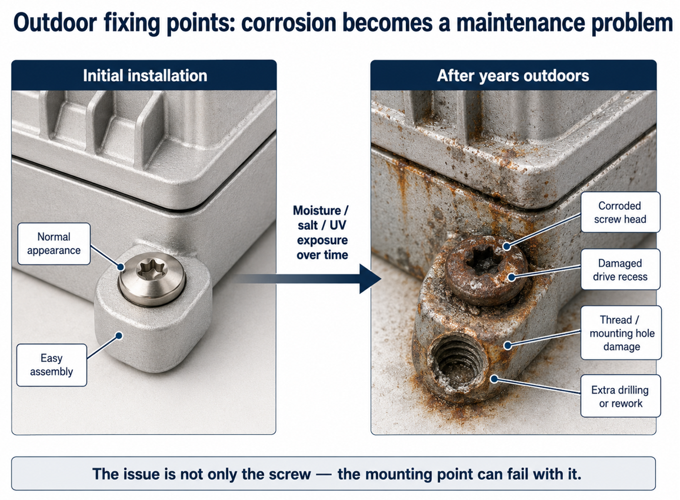
In field service, the most disruptive issue is often not a failed module. It is a fastener that will not come out. Corroded heads, stripped drives, and damaged threads can turn routine disassembly into drilling, thread repair, or replacement of part of the enclosure.
For a mechanical design engineer, three questions are a useful starting point: Is this a primary load-bearing point? Will it see long-term exposure to moisture, salt spray, or UV? If it seizes, will it interfere with module replacement, enclosure access, or cable service?
If the answers point to a non-primary location, a harsh environment, and high service cost, that fastening point deserves attention early in the design process.
2. There Are Several Ways to Manage Outdoor Corrosion—Engineering Plastics Are One of Them
Outdoor corrosion is not always solved by changing materials. Designers may use compatible metals, surface treatments, stainless steel, sealing washers, sealants, drainage features, or scheduled maintenance. Each of those approaches can be valid.
Engineering plastic fasteners are most relevant where the goal is to keep a mounting point from continuing a metal-to-metal contact path or contributing to galvanic corrosion. For example, when an aluminum enclosure, a metal bracket, and steel fasteners share a wet environment, the hole, threads, and washer interface can become a focal point for corrosion.
At those locations, PVDF screws, non-metallic washers, bushings, sleeves, or hole-isolation components can separate direct metal contact. They will not solve every outdoor exposure issue, but they can remove a high-risk fastening point from the corrosion chain.
3. Which Outdoor Telecom Locations Should Be Reviewed First?
Outdoor equipment varies widely in form and construction, but fastening risks can usually be organized around environmental exposure, service access, load, and part function. The table below highlights several common locations and the part types worth discussing first.
| Equipment / Location | Common Issue | Parts Worth Discussing First |
|---|---|---|
| Outdoor base stations, coastal sites, or high-humidity environments | Corroded screws, seized mounting holes, or long-term direct contact between aluminum housings and steel fasteners. | Insulating washers, hole-isolation bushings, non-metallic screws and nuts, and custom isolators designed around the mounting hole and assembly. |
| Small cells and roadside communication equipment | Tight packaging and limited service access; a seized fastener or hard-to-remove part can extend repair time. | Quick-release clips, living hinges, tool-free retention features, custom locating parts, and small support components. |
| Outdoor radomes and external support structures | Long-term UV, heat, moisture, and fit requirements; local isolation may also be needed between the cover, bracket, and fastener. | Weather-resistant plastic rivets, cover clips, antenna-bracket isolator blocks, spacers, and locating features. |
| Outdoor enclosure clamps, cable retention, and venting areas | Moisture, sunlight, drainage, and chemical contamination often concentrate around external small parts that may also require repeated removal. | Weather-resistant cable ties, heavy-duty clamps, cable mounts, breather-vent housings, and protective guards. |
| Outdoor telecom power enclosures | Outdoor exposure and internal heat exist at the same time, while temperature, load, and insulation requirements vary by mounting point. | Internal cable mounts, power-module isolating standoffs, heat-resistant supports, transformer-area brackets, and custom small parts. |
The parts listed above do not map automatically to one fixed material just because they are used in a certain equipment category. The same clamp, isolator, or fastener may require a different material and process depending on direct exposure, load, nearby temperature, and how often it must be removed.
Once the location and part function are clear, the next step is to compare weatherability, strength, dimensional stability, heat resistance, chemical resistance, and cost together.
4. Material Selection Should Follow the Environment, Function, and Load
The goal is not to rank materials from low to high. It is to confirm whether a material can support the operating environment, the function of the part, the manufacturing route, and the long-term load at the same time. The table below summarizes common material directions for outdoor telecom equipment and the limits that should be checked before use.
| Material Direction | Best-Fit Parts / Conditions | What to Confirm Before Use |
|---|---|---|
| PVDF | Screws, washers, bushings, sleeves, and hole-isolation parts in salt spray, moisture, or chemically corrosive environments. | Long-term load, creep, service temperature, clamp force, and actual grade properties. |
| Weather-resistant PA / PA12 | External fasteners, clamps, clips, and parts that require repeated assembly, lower moisture uptake, or improved dimensional stability. | UV stabilization, moisture absorption, stiffness, impact performance, and long-term load. |
| POM | Quick-release clips, living hinges, sliding parts, and moving mechanisms that need wear resistance, low friction, or elastic recovery. | UV exposure, strong acids and alkalis, flammability limits, and high-temperature capability; outdoor use requires an appropriate weather-resistant grade. |
| PBT / PBT+GF | Internal mounts, precision supports, connector-adjacent parts, and components that require dimensional stability and electrical insulation. | Hydrolysis risk in hot and humid conditions, impact strength, reinforcement level, and flammability rating. |
| Weather-resistant PC / ASA | Cover clips, appearance parts, housing-adjacent fasteners, and components that need impact resistance or visual integration. | Chemical exposure, stress cracking, long-term load, and actual UV rating. |
| Weather-resistant PP | Lower-load, cost-sensitive clamps, cable-retention parts, guards, and external protective components. | Generally not suitable as a primary load-bearing fastener; confirm low-temperature impact, UV resistance, stiffness, and installation conditions. |
| PPS / PPS+GF | Supports or isolators inside telecom power enclosures or semi-sheltered areas near heat sources where low moisture uptake, heat resistance, and dimensional stability are needed. | Impact performance, design stress, direct UV exposure, and actual grade properties; not a universal solution for every outdoor location. |
| PEEK | A limited number of fastening or isolation points where high temperature, higher load, dimensional stability, and long-term reliability requirements overlap. | Cost, necessity, UV and outdoor exposure, fastening design, and grade-specific properties. |
5. Start with the Fastening Points That Are Hardest to Service
Not every metal screw needs to be replaced with a non-metallic part. A practical starting point is to review locations with high corrosion risk and high service cost that are not responsible for primary structural load, grounding, or shielding.
In a base station, small cell, roadside unit, outdoor fiber enclosure, or telecom power cabinet, a seized fastening point can affect module replacement, cover removal, cable service, or reuse of the mounting hole. At that point, the issue is no longer a single screw—it may become drilling, thread repair, or local structural rework.
Link Upon can help review these higher-risk fastening points and determine whether an existing standard part will work. When hole size, thickness, length, geometry, or assembly conditions fall outside available specifications, CNC-machined or injection-molded custom parts can also be evaluated from the drawing.
This article is part of the “Pain Points in Electronic and Communication Equipment Components” series.
- Part 1: Which Outdoor Telecom Fastening Points Are Good Candidates for Weather-Resistant Non-Metallic Parts?
- Part 2: When Should Small Parts in PCB and Power Modules Be Re-Evaluated?
- Part 3: How to Turn Non-Metallic Requirements Around RF Connectors and Antennas into Manufacturable Parts
Note
This article provides general material and application guidance. Final material selection should be based on equipment structure, environmental conditions, grade-specific data, load, fastening method, safety requirements, UV and salt-spray exposure, and customer specifications.
