
Engineering plastic components used in medical equipment are not intended to replace metal simply for cost savings. Their value lies in providing more suitable physical properties and design flexibility in environments where metal can be limiting. From low-friction motion in oil-free or low-lubrication areas, to non-magnetic fastening around MRI systems, radiolucent components for image-guided procedures, and low-attenuation parts in radiotherapy equipment, high-performance engineering plastic components can help reduce concerns related to electrical conduction, magnetic interference, image obstruction, radiation attenuation, friction and wear, and corrosion.
These components may not directly contact the patient or the sample, but they can still affect assembly stability, electrical isolation, sliding support, clearance control, image interpretation, positioning accuracy, and long-term reliability. Typical products include plastic screws, nuts, washers, spacers, standoffs, insulating sleeves, bushings, rollers, cable ties, custom injection-molded parts, and CNC-machined components.

Core Concept: Use Zone-Based Material Selection, Not PEEK for Every Part
Before discussing specific applications, one key point should be made clear: material selection inside medical equipment should not be based only on which material is the most advanced. A more practical approach is to select materials by function, location, and environmental conditions.
PEEK performs well in locations requiring high strength, high temperature resistance, non-magnetic properties, and radiolucency. However, in dry, low-friction guiding areas, POM may provide a lower coefficient of friction at a more practical cost. Around chemical fluids, PVDF may offer better resistance to strong oxidizers than PEEK. Replacing every part with PEEK can be unnecessarily expensive and may not be the best technical choice.
| Requirement | Material Direction |
|---|---|
| High temperature / high strength | PEEK, PPS, PEI |
| Insulation / dimensional stability | PPS, PEI, PEEK |
| MRI-adjacent / non-magnetic fastening | PEEK, PEI, PPS (confirm according to validation conditions) |
| Radiolucency / low radiation attenuation | PEEK, PEI, PPS (confirm according to equipment location) |
| Sliding / guiding / roller | POM, Nylon, PEEK (Nylon is recommended for dry areas or low- to medium-risk mechanical locations) |
| Clearance control / washer / spacer | POM, PPS, PEEK, PP |
| Chemical surroundings | PVDF, PFA / PTFE, PP |
| Long-term wet areas or cleaning environments | PVDF, PP, PFA / PTFE, PEEK, PPS |
The Value of Engineering Plastic Components: Not Replacing Metal, but Solving Its Physical Limitations
Inside medical equipment, many plastic fasteners and mechanical components are not located in the core fluid path and do not directly contact patients or samples. Even so, they can affect long-term equipment stability and assembly quality.
In areas such as PCB mounting, power modules, sensor modules, pump surroundings, cable management, MRI-adjacent assemblies, image-guided surgical systems, and radiotherapy equipment, the value of engineering plastic components is not to replace metal everywhere. It is to provide a more suitable material solution in specific locations where metal may introduce electrical conduction, magnetism, image obstruction, corrosion, weight, friction, or assembly limitations.
| Application Location | Possible Products | Material Direction | Main Value |
|---|---|---|---|
| PCB / control board fastening | Plastic screws, standoffs, spacers | PPS, PEI, PEEK | Insulation, dimensional stability, support |
| Power module / highly sensitive circuit area | Insulating washers, bushings, insulating sleeves | PEI, PPS, PEEK | Insulation, isolation, avoiding metal conduction |
| Around pumps / valves / motors | Plastic screws, nuts, washers | PEEK, PPS, PVDF, POM | Fastening, heat resistance, resistance to surrounding chemical environments |
| Around precision gear pumps / metering pumps | Washers, spacers, bushings, rollers | POM, PEEK, PPS | Clearance control, sliding support, low friction |
| Cable management | Cable ties, tube clamps, fixing clips | PEEK, PVDF, PP | Cable fixing, insulation, heat / moisture resistance |
| MRI-adjacent / signal-sensitive areas | Plastic screws, nuts, washers, spacers | PEEK, PEI, PPS | Non-magnetic, non-conductive, reduced interference concerns |
| Image-guided surgical systems | Plastic screws, bushings, spacers, front-end support components | PEEK, PEI, PPS | Radiolucency, reduced image obstruction, lightweight design |
| Radiotherapy equipment / patient positioning devices | Plastic screws, brackets, spacers, standoffs | PEI, PEEK, PPS | Low radiation attenuation, dimensional stability, positioning support |
Precision Motion and Fluid Management: Mechanical Support and Low-Friction Components in Dialysis Equipment
A hemodialysis machine is not only a fluid control system; it is also a precision electromechanical system designed for long-term operation. Between the blood pump, monitoring modules, dialysate supply, and door / cover mechanisms, there are many non-metallic support components that require stability, low friction, and controlled clearance.
In these applications, engineering plastics such as POM and PPS can help address wear, noise, and vibration concerns that metal may face in oil-free or low-lubrication environments. The primary role of POM rollers, swing washers, hinge spacers, flange washers, and similar parts is not biocompatibility, but friction management, rotational support, clearance control, and operating stability.
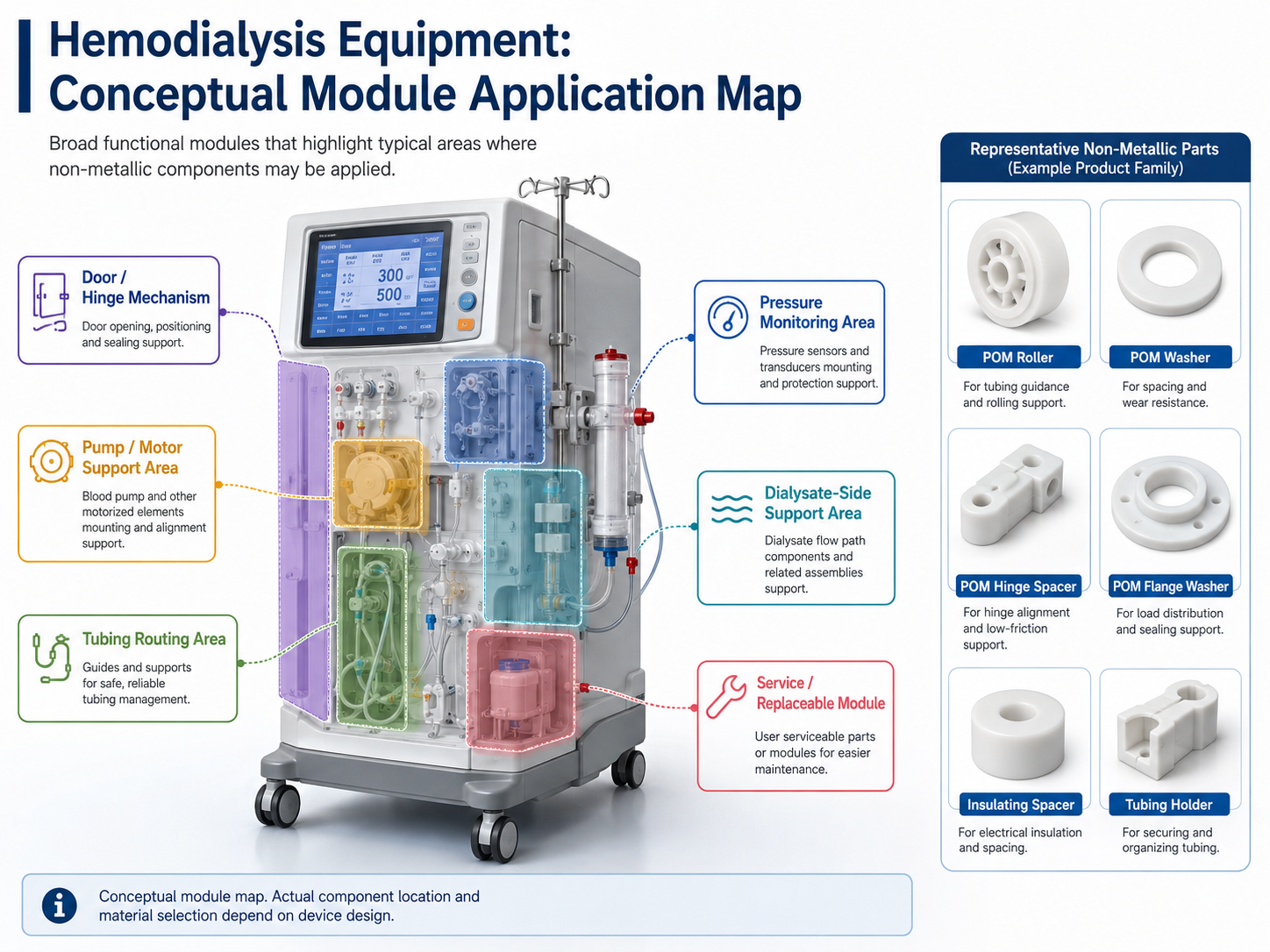
| Application Area in Dialysis Equipment | Possible Parts | Materials to Consider | Main Function |
|---|---|---|---|
| Around pump / motor mechanisms | Rollers, washers, spacers | POM, PEEK, PPS | Sliding, support, wear resistance, positioning |
| Door / hinge / cover mechanism | Hinge spacers, flange washers | POM, PP, PPS, PEEK | Rotational support, clearance control, reduced wear |
| Tubing routing / module support | Tube clamps, holders, spacers | PP, POM, PVDF, PEEK | Tubing guidance, fixing, avoiding interference |
| Sensor / pressure monitoring module | Insulating washers, sleeves, spacers | PEI, PPS, PEEK | Insulation, isolation, positioning |
| Around dialysate supply area | Washers, brackets, custom parts | PVDF, PP, PPS, PEEK | Wet-area fixing, chemical resistance, dimensional stability |
| Maintenance / replaceable module | Knobs, bushings, washers | POM, PP, PEEK | Repeated disassembly, low friction, wear resistance |
Around Precision Gear Pumps: Clearance Control and Low-Friction Support
In hemodialysis equipment or related fluid control modules, if precision gear pumps, metering pumps, motor drives, or guide support structures are involved, washers, spacers, and bushings are not merely auxiliary parts. They may also influence rotational stability, output precision, and long-term wear performance.
For example, in the axial transmission structure of a gear pump, precision washers or spacers can help control physical clearance between components. Bushings can provide low-friction support, helping reduce operating noise and axial or radial wear.
From a material selection perspective, POM is suitable for dry-area or mechanical transmission locations that are not exposed to high temperature or strong corrosion. POM has one of the lower coefficients of friction among commonly used engineering plastics and also offers good dimensional stability. If the application is near a high-temperature thermal disinfection path, strong cleaning agents, or higher load conditions, higher-performance materials such as PEEK, PPS, PVDF, or PFA / PTFE can be further evaluated.
Further Reading | Next Article
Next up: we’ll explore how engineering plastic parts are used in non-magnetic fastening and radiolucent applications.
