
The electronics and communications industry continues to advance toward higher speeds, higher frequencies, and greater reliability. As conventional plastics and metals reach their limits in high-performance applications, high-performance engineering plastics have become essential for modern equipment design.
Engineering plastics are used not only in precision electronic components but also in structural elements such as plastic screws, insulating fasteners, standoffs, clips, and washers. While often regarded as minor components, they play an essential role in ensuring equipment stability, electrical safety, and signal performance.
Link Upon specializes in engineering plastic solutions for demanding electronic applications. Below are several commonly used high-performance engineering plastics and their key advantages.

1. Key Functions in Electronics and Communications
High-Precision Structural Support
Engineering plastics offer low moisture absorption, low thermal expansion, and high rigidity, helping maintain dimensional stability in connectors, optical communication modules, and electronic assemblies.
Electrical Insulation and EMI Reduction
Compared with metal fasteners, plastic screws and washers provide electrical insulation, reducing the risks of short circuits, unintended conduction, and EMI. In high-frequency communication modules, PCB assemblies, and server systems, non-metallic fasteners can also help minimize interference and parasitic effects.
Resistance to Heat and Chemicals
Semiconductor equipment, battery modules, and high-frequency test fixtures often operate in harsh environments. Engineering plastic components with excellent heat resistance, chemical resistance, and dimensional stability help extend service life and reduce maintenance risks.
2. Common High-Performance Engineering Plastics
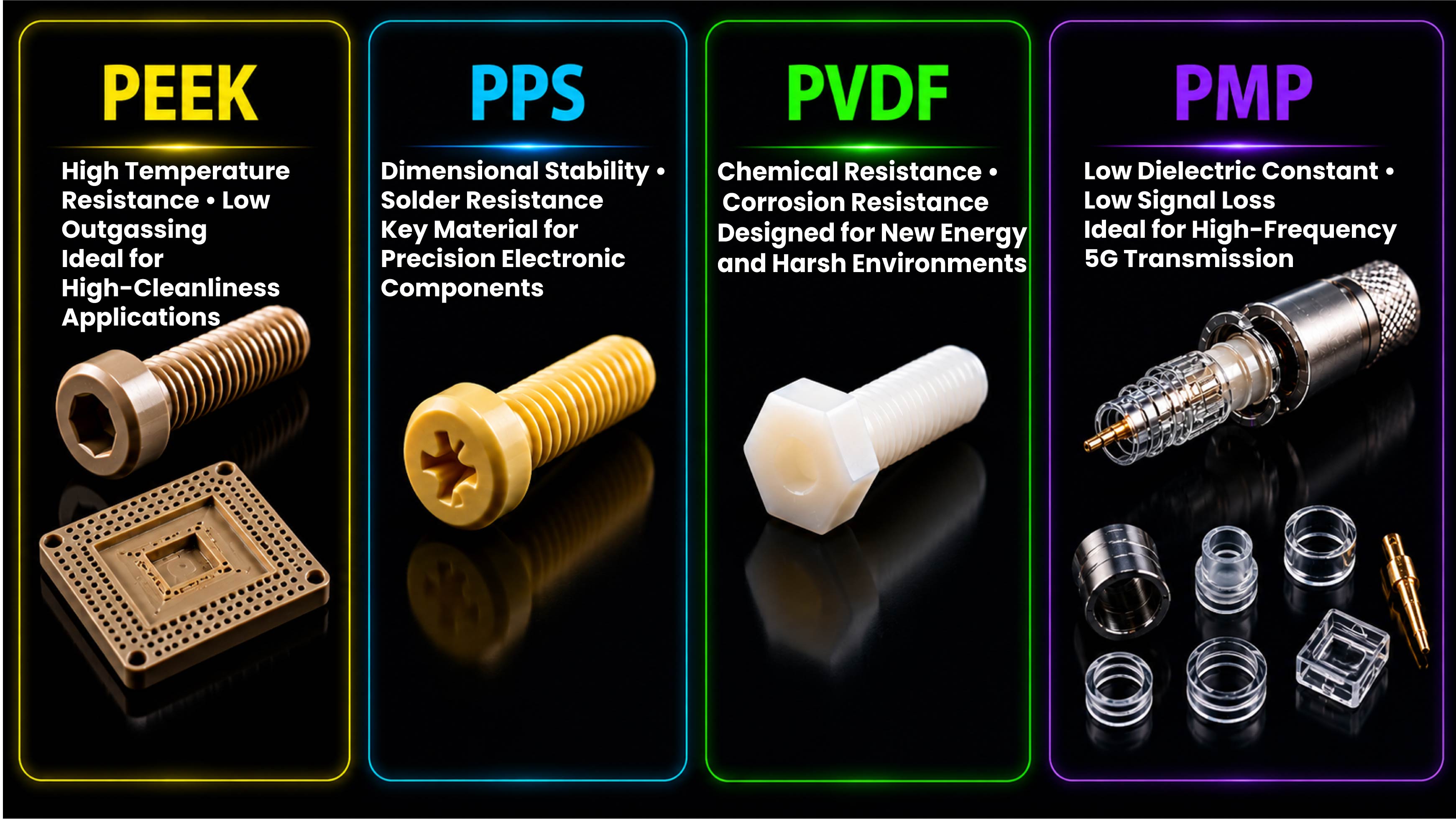
PEEK (Polyether Ether Ketone)
Excellent heat resistance, high mechanical strength, and low outgassing; suitable for cleanroom or high-purity, high-temperature environments, with long-term service temperatures up to approximately 260°C.
PPS (Polyphenylene Sulfide)
Low moisture absorption, excellent dimensional stability, and strong heat and chemical resistance make PPS ideal for mounting bases, insulating components, and precision structural parts in demanding electronic applications. Long-term operating temperatures can reach approximately 200°C.
PVDF (Polyvinylidene Fluoride)
Outstanding corrosion resistance, UV resistance, and piezoelectric properties; widely used in chemical and renewable energy applications.
PMP (Poly-4-Methyl-1-Pentene)
With its extremely low dielectric constant and dissipation factor (Low Dk/Df), PMP helps reduce signal loss in high-frequency transmission. It can minimize signal reflection, interference, and parasitic effects, improving signal stability in 5G and other high-frequency communication applications.
3. Conclusion
Engineered plastic components play a critical role across 5G communications, AI servers, and semiconductor equipment, ensuring signal integrity, process stability, and long service life. These plastic parts are increasingly replacing metal components such as PEEK screws, PEEK washers, PVDF fasteners, Nylon clips, and precision structural PPS parts, delivering reliable performance in high-frequency, high-purity, and high-reliability environments.
As industries advance toward 6G, AIoT, and high-performance computing, material and component selection will remain key to next-generation hardware performance.
Looking for solutions in 5G communications, precision electronics, or high-performance engineering plastics parts?
Contact Link Upon to discuss the right plastic components and manufacturing options.
