Some functions of this website do not support IE browser, please use other browsers such as Chrome or Edge.

Plastic Bushing

Plastic bushings are used outside of mechanical parts to protect metal counterparts or abrasive parts from wear due to long-term rotation.
 

Plastic Bushing | Engineering Plastic Bushing for Wear Protection

Plastic bushings are used outside of mechanical parts to protect metal counterparts or abrasive parts from wear due to long-term rotation.

Multiple engineering plastic materials are available according to operating temperature, chemical environment, wear resistance, mechanical strength, and application requirements.

Protects Metal Counterparts Reduces Rotational Wear Wear-Resistant Materials Multiple Material Options

Advantages of Plastic Bushings

Plastic bushings are used outside of mechanical parts to protect metal counterparts or abrasive parts from wear due to long-term rotation.

  • Protection for Metal Counterparts
  • (Helps reduce direct contact and wear between metal parts).
  • Reduced Rotational Wear
  • (Suitable for long-term rotating or sliding applications).
  • Multiple Engineering Plastic Materials
  • (Material selection can be based on temperature and operating conditions).
  • Application Flexibility
  • (Suitable for different mechanical parts and industrial equipment).

Typical Material Selection Scenarios

High-Temperature and High-Strength Applications

PEEK, PPS, and TPI Self-lubricating provide options for elevated temperatures, mechanical strength, dimensional stability, and demanding industrial environments.

Chemical and Electrical Applications

PVDF, PP, and PTFE provide options for chemical resistance, electrical properties, hydrolysis resistance, non-stick performance, and lubrication.

General Wear and Mechanical Applications

NYLON and POM provide options for wear resistance, high hardness, low friction, rigidity, and dimensional stability.

※ Actual material selection should be evaluated according to operating temperature, mechanical load, rotational speed, friction conditions, chemical environment, dimensional requirements, and product structure.

Plastic Bushing Material Selection Guide | Temperature Ranges and Applications

Material Selection: Multiple engineering plastic materials are available according to different operating environments and temperature requirements.

PEEK | Long-term use temperature 240℃

PEEK is a semi-crystalline engineering plastic, suitable for applications that used in high temperature, chemical solvent process. PEEK material is tough, rigid, creep-resistant, light-resistant, and multi-ray resistant.

Screws, nuts, and various spare parts made of this material are widely used in semiconductor equipment, aerospace vehicle industry, automotive electronics and motor industry, oil/gas extraction equipment and even medical equipment or food production equipment.

PPS | Long-term use temperature 200℃

PPS is a thermoplastic special engineering plastic, featuring high temperature resistance, corrosion resistance and high mechanical strength.

In addition, it has electrical properties and dimensional stability which allows PPS-made parts suitable for electronic and electrical parts, auto parts, and chemical machinery parts.

PVDF | Long-term use temperature 150℃

PVDF is a thermoplastic fluoropolymer with excellent chemical resistance, weather resistance, high temperature resistance, electrical insulation, lubrication, and wear resistance.

It is suitable for various environments of acid-base solvent, semiconductor manufacturing processes, wet chemical processes, and equipment parts in the chemical industry.

PP | Long-term use temperature 90℃

PP features excellent stretchability, chemical resistance, hydrolysis resistance, electrical properties, and is suitable for use in various chemical environments, food production equipment and pharmaceutical machinery parts.

PTFE | Long-term use temperature -190~260℃

PTFE is one of the fluorine-based resins, which is resistant to most chemicals and solvents.

Due to excellent electrical properties, non-stick and lubricity, it is widely used in high temperature, chemical, electrical, mechanical and aviation fields.

NYLON | Long-term use temperature 70℃

Nylon plastic has heat resistance, high hardness, wear resistance, and low friction coefficient.

It is suitable for parts in mechanical engineering, food technology, electronics aviation, aerospace technology, and automotive industry.

TPI Self-lubricating | Long-term use temperature -269~280℃

TPI has excellent high-temperature resistant, wear resistance and friction performance under high pressure and high-speed scraping.

Low gas performance under high vacuum state, excellent chemical resistance and mechanical properties, extraordinary dimensional stability, and low electrical conductivity.

POM | Long-term use temperature 100℃

Also known as plastic steel with high rigidity, low friction, and dimensional stability.

Resistant to most chemical solvents (non-acidic) and oils.
Would you like to learn more about Plastic Bushing materials, temperature ranges, dimensions, or custom manufacturing options?

Contact Link Upon 

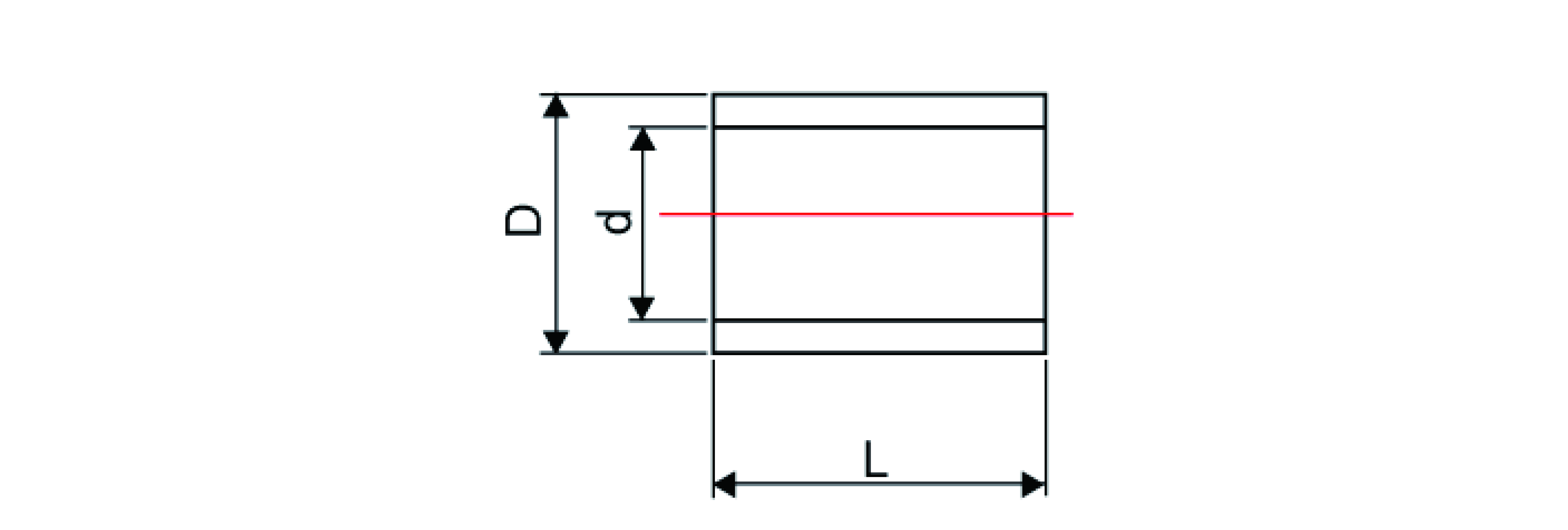
Plastic Bushing Metric Specification

The table below lists standard metric dimensions in millimeters (I.D. × O.D. × Length). For customized sizes or special requirements, please contact us.

d (I.D./mm) D (O.D./mm) L (Length/mm)
1.5 4 2.1
1.5 4 4.2
1.5 4 4.4
2 5 4.8
3 6 5
4 7 6
5 8 6
6 9 8
7 11 8
8 12 8
9 13 10
10 14 10
15 20 30
17 23 15
20 40 50.5
22 28 20
30 36 30
35.2 50.5 50
50.2 70.5 50
65.2 85.5 70
80.2 100 80
Let us solve problem